
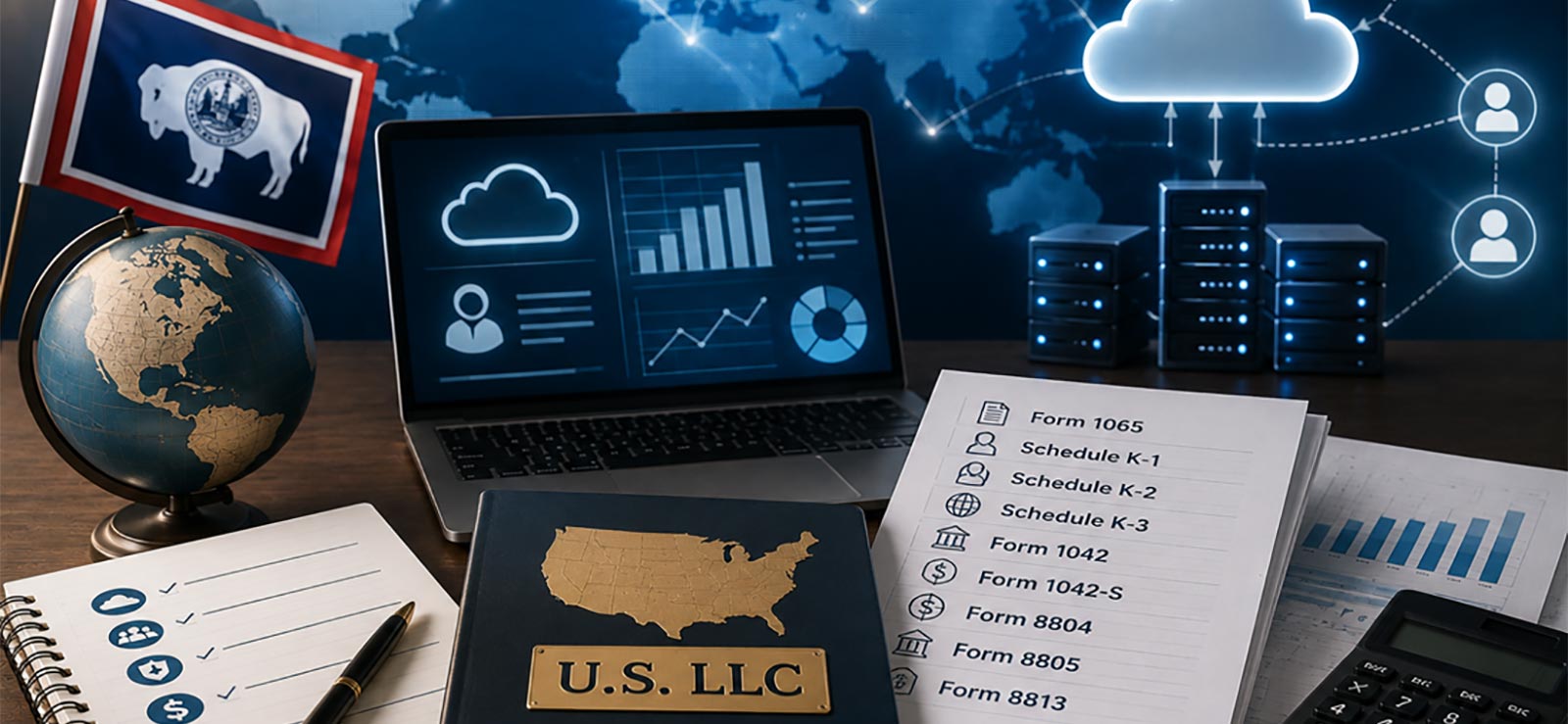
Foreign Owned Wyoming Saas LLC Tax Guide
Foreign-Owned Wyoming SaaS LLC Tax Guide
Form 1065, Schedules K-1/K-2/K-3, cloud-transaction sourcing, AWS hosting, Forms 1042/1042-S, and section 1446 withholding
Who This Applies To
- A Wyoming or other U.S.-formed LLC with two or more members and no corporate election.
- All members are non-U.S. individuals who live and work outside the United States.
- The business sells monthly or annual access to hosted software, a database, an MRP platform, or another SaaS product.
- Customers are located in the United States and other countries.
- The business has no U.S. office, employees, or founders physically working in the United States.
- The platform uses AWS or another third-party cloud provider, including one or more U.S. server regions.
- The partnership makes cash distributions to its foreign members.
- The owners need to determine whether Form 1065, K-1, K-2/K-3, 1042/1042-S, 8804/8805/8813, or partner-level Form 1040-NR applies.
Core Tax Rule in One Paragraph
A domestic multi-member LLC classified as a partnership generally files Form 1065 and passes its tax items to the members through Schedules K-1. For a foreign-owned SaaS partnership, the U.S. tax analysis must be performed in sequence: first classify the customer transaction; then determine whether the resulting income is U.S.-source, foreign-source, or mixed-source; then determine whether any U.S.-source amount is effectively connected with a U.S. trade or business. The selected withholding and partner-level forms follow from those conclusions. A U.S. LLC, U.S. bank account, U.S. customer, or U.S. cloud region does not independently answer all three questions.
The Four-Step Decision Tree
| 1. Character | What does the customer receive: hosted access, downloadable software, copyright rights, customization, or another distinct product? |
| 2. Source | Where is the cloud service performed under the law applicable to the tax year? Review personnel, software-development activity, intellectual property, and infrastructure. |
| 3. Connection | Does the partnership conduct a U.S. trade or business, and is any U.S.-source income effectively connected with that business? |
| 4. Reporting | Use Form 1065 and partner schedules in all cases; add chapter 3 or section 1446 forms only when the underlying income and withholding rules require them. |
Frequently Asked Questions
1. How is a two-member Wyoming LLC classified for federal tax purposes?
A domestic LLC with two members is generally classified as a partnership unless it files Form 8832 to elect corporate treatment.
The partnership generally must:
- File Form 1065 for each required tax year.
- Issue Schedule K-1 to every person who was a partner during the year.
- Track each partner’s ownership, contributions, distributions, liabilities, and capital activity.
- Evaluate the relevant portions of Schedules K-2 and K-3 because the partners are foreign and the income has international source and character issues.
Form 1065 is primarily an information return. The partners generally bear the ultimate income-tax consequences, while the partnership may have separate withholding obligations.
2. Does the LLC still file Form 1065 when both owners live outside the United States?
Generally, yes. The LLC is a domestic partnership because it was organized under U.S. state law. Foreign ownership does not convert it into a foreign partnership or eliminate the domestic filing requirement.
A domestic partnership with subscription revenue, AWS charges, formation costs, or partner distributions normally files Form 1065 even when the revenue is modest and neither partner has entered the United States. The filing obligation is separate from whether the partners ultimately owe U.S. income tax.
3. Is hosted subscription software treated as services, rent, or royalties?
The answer begins with what the customer actually receives. A customer who receives on-demand access to hosted software and a database, cannot download the core program, receives no source code, and loses functionality when the subscription ends usually fits the cloud-transaction model.
Final Treasury Regulation §1.861-19 classifies a cloud transaction as the provision of services for the international-tax provisions listed in the regulation. The result can differ when the customer receives a permanent downloadable copy, source code, or material rights to reproduce, modify, distribute, or commercially exploit the software.
4. Does an online MRP platform normally qualify as a cloud transaction?
It commonly does when customers log into a hosted platform to use inventory, bill-of-material, workflow, or database functions while the provider retains control of the software and infrastructure.
The service characterization is strengthened when:
- The core software remains on the provider’s servers.
- The customer receives no source code or copyright exploitation rights.
- Access depends on a continuing subscription.
- The provider maintains, updates, secures, and operates the platform.
- Any downloaded app or script is merely ancillary to the hosted functionality.
A separately priced downloadable enterprise product or a separate intellectual-property license must be analyzed independently or under the predominant-character rule.
5. Do the final cloud-classification regulations apply to a 2024 or 2025 calendar-year return?
Not automatically. The final regulations generally apply to taxable years beginning on or after January 14, 2025. A calendar-year 2024 return began before that date. A calendar-year 2025 return also began on January 1, 2025, before the general applicability date.
The regulations permit early application to qualifying years beginning on or after August 14, 2019, but only if the taxpayer and related persons satisfy the consistency, open-statute, and accounting-method conditions stated in the regulations. A calendar-year 2026 partnership generally falls within the mandatory applicability period.
6. Does services classification automatically make all SaaS revenue foreign-source?
No. Character and source are different questions. Services income is generally sourced where the services are performed, but identifying the place of performance for an automated cloud platform is more difficult than identifying where an individual consultant worked.
For years not governed by a finalized cloud-specific sourcing rule, the partnership must apply existing statutory, regulatory, and judicial principles to its facts. The 2025 proposed sourcing regulations are useful as an analytical framework, but a proposal is not binding law unless and until finalized.
7. What would the proposed cloud-sourcing formula examine?
REG-107420-24 proposes a formula based on three groups of resources used by the legal entity earning the cloud revenue:
- Intangible-property costs, including specified research and experimental expenditures and certain royalty or amortization costs.
- Personnel who directly develop, configure, deliver, operate, maintain, secure, or support the cloud service.
- Tangible property directly used to provide the service, measured through depreciation and rental expense.
The proposed formula would allocate gross income between U.S. and foreign sources based on the U.S. and worldwide portions of those factors. It generally would not source the income merely by customer location or contract-signing location.
8. Do U.S. customers make the subscription revenue U.S.-source?
Not by themselves. Customer residence, billing address, card location, and payment currency may be relevant to state sales-tax or commercial questions, but they do not independently determine the federal source of cloud-services income.
The federal analysis focuses on where the service is performed under the law applicable to the year. For a cloud business, that may require evidence concerning development personnel, technical operations, intellectual property, AWS regions, and other service-delivery resources.
9. Does using U.S.-based AWS infrastructure create U.S.-source income?
It is relevant, but it does not create an automatic all-or-nothing result. Under the proposed cloud-sourcing formula, rental expense for tangible property directly used to provide the cloud service would be part of the tangible-property factor. U.S.-located AWS capacity could therefore contribute to a U.S.-source fraction.
The effect depends on the actual AWS arrangement, including the regions used, whether capacity is dedicated or shared, whether the partnership selects the region, and the relative importance of U.S. infrastructure compared with foreign development and operations. Because the formula remains proposed, the return position must be supported under the law applicable to the year, with the proposal treated as persuasive rather than binding authority.
10. Does AWS hosting in the United States automatically create a U.S. trade or business?
No automatic rule treats every foreign-operated SaaS partnership using U.S. cloud infrastructure as engaged in a U.S. trade or business. The analysis is fact intensive.
Important facts include:
- Whether the partnership controls or has dedicated use of identifiable equipment.
- Whether U.S. employees, contractors, or agents perform core technical or commercial functions.
- Whether the partnership has a U.S. office or other place available for conducting its business.
- Whether material contracts are negotiated or concluded in the United States.
- Whether the U.S. activity is continuous, substantial, and central to earning the revenue.
A third-party shared-cloud contract, registered agent, or virtual mailbox is generally less significant than U.S. personnel or a controlled operating facility. Treaty protection, if available, requires a separate partner-by-partner residence and eligibility analysis.
11. When are Forms 1042 and 1042-S relevant?
Forms 1042 and 1042-S generally report U.S.-source income paid or allocated to foreign persons under chapters 3 and 4, including U.S.-source FDAP income. Examples can include interest, royalties, rents, and certain non-effectively connected compensation.
The forms are not triggered merely because the LLC has foreign owners or transfers cash to them. The partnership first must identify U.S.-source income that falls within the chapter 3 or chapter 4 reporting system, determine the beneficial owner and documentation, apply any treaty rate, and comply with withholding and deposit rules.
12. If the subscription is services income, are Forms 1042 and 1042-S automatically eliminated?
No. Services characterization narrows the analysis but does not finish it.
- Foreign-source services income is generally outside chapter 3 withholding.
- U.S.-source services income that is effectively connected with a U.S. trade or business is generally addressed through section 1446 for foreign partners.
- U.S.-source services income that is not effectively connected can require a separate FDAP and chapter 3 analysis.
- Payments by the partnership to foreign contractors or licensors must be analyzed separately from the partnership’s own subscription revenue.
The correct form follows from character, source, recipient status, and ECI—not from the label “SaaS” alone.
13. What happens if the partnership has effectively connected taxable income?
An ordinary domestic partnership with effectively connected taxable income allocable to foreign partners generally uses the section 1446(a) withholding system:
- Form 8813 for installment payments during the year.
- Form 8804 for the annual partnership withholding return.
- Form 8805 for each foreign partner’s allocable ECTI and withholding credit.
The withholding obligation is based on allocable ECTI, not the amount of cash distributed. A partnership may owe withholding even when it retains all cash. Forms 1042 and 1042-S are not the ordinary ECI-reporting mechanism for a non-publicly traded LLC partnership.
14. Are cash withdrawals by the partners reported on Form 1042-S?
Ordinary cash withdrawals are generally partnership distributions. They are recorded on the books, reflected in partner capital and basis records, and reported on Schedule K-1 when applicable. They are not automatically wages, royalties, or FDAP payments.
A distribution is also different from a partner’s distributive share of income. A partner may be allocated taxable income without receiving cash, or receive cash that differs from the current-year income allocation. A distribution can produce gain if it exceeds the partner’s adjusted outside basis, so each partner must maintain basis records.
15. What does Schedule K-1 report for each foreign member?
Schedule K-1 generally reports the partner’s share of ordinary business income or loss, separately stated items, ownership percentages, liabilities, distributions, and tax-basis capital information when required.
Each foreign individual partner should provide a current Form W-8BEN to document foreign status. The partnership should also collect the partner’s legal name, foreign address, citizenship, tax residence, foreign TIN, U.S. TIN if available, admission date, ownership percentage, contributions, and distributions.
16. Are Schedules K-2 and K-3 required for a foreign-owned SaaS partnership?
The partnership must evaluate the relevant parts. Schedule K-2 extends Schedule K and reports partnership-level international items; Schedule K-3 gives each partner the applicable share of that information.
A partnership owned entirely by nonresident aliens generally cannot use the domestic filing exception that requires qualifying U.S. direct partners. Part X generally applies to partnerships with foreign partners, but a domestic partnership may omit Part X when it has no ECI and all applicable chapter 3 and chapter 4 withholding and reporting obligations have been satisfied. Other parts may still apply when the partnership has tax-relevant foreign-source or mixed-source items.
K-2 and K-3 do not simply list every customer country. They report tax-relevant character, source, deductions, withholding, and partner-allocation information. The partnership should use the instructions for the specific tax year.
17. Must each foreign partner file Form 1040-NR?
Not solely because the partner owns an interest in a U.S. LLC. A foreign individual commonly has a Form 1040-NR filing requirement when the individual is engaged in a U.S. trade or business through the partnership, receives ECI, claims a section 1446 withholding credit, seeks a refund, or has other taxable U.S.-source income.
A foreign partner treated as engaged in a U.S. trade or business will generally need a U.S. taxpayer identification number. If the partnership has only foreign-source income, no ECI, and the partner has no separate U.S. filing trigger, ownership alone may not require Form 1040-NR.
18. What records should a small SaaS partnership keep?
The revenue amount may be small, but the international analysis is evidence driven. The partnership should maintain:
- Subscription revenue by product and period.
- Customer country and billing data, while recognizing that customer location is not the sole federal sourcing factor.
- AWS invoices by region, service category, and period.
- Software-development and technical-support costs.
- The physical work locations of founders, employees, and contractors.
- Documentation showing who owns, develops, and manages the intellectual property.
- Partner contributions, loans, distributions, and capital-account activity.
- Foreign-exchange calculations, payment-processor reports, refunds, and chargebacks.
- Year-end bank balances, receivables, payables, and capitalized assets.
These records support Form 1065, K-2/K-3, the source analysis, and any conclusion that chapter 3 or section 1446 withholding does not apply.
19. What state obligations remain separate from the federal analysis?
The LLC must maintain its Wyoming legal status, including its registered agent and annual report. Federal income-source conclusions do not determine state sales-tax or economic-nexus obligations.
A SaaS business with customers in multiple states should separately evaluate whether each state taxes the particular SaaS product and whether sales, transaction, or physical-presence thresholds have been exceeded. The existence of U.S. customers can matter greatly for state sales tax even when it does not control federal cloud-income sourcing.
Common Mistakes
Treating every SaaS payment as a royalty.
Fix: Hosted access without transferred copyright rights often fits a cloud-services analysis. Identify exactly what the customer receives.
Stopping after the services classification.
Fix: Character, source, and ECI are separate determinations. Complete all three before selecting withholding forms.
Assuming foreign founders make every dollar foreign-source.
Fix: Document personnel, intellectual property, development, operations, and infrastructure, including U.S. AWS regions.
Using customer location as the federal source rule.
Fix: Customer location can matter for sales tax, but cloud-service performance requires a resource-based federal analysis.
Issuing Form 1042-S for every distribution.
Fix: First determine whether the partnership has U.S.-source FDAP, ECTI, or only foreign-source income.
Ignoring AWS because it is a third-party provider.
Fix: Third-party U.S. infrastructure may be relevant to sourcing and business-connection analysis even when it is not decisive.
Deadlines and Penalty Exposure
Form 1065 and Schedule K-1
A calendar-year partnership generally files Form 1065 and furnishes Schedules K-1 by March 15. A timely Form 7004 generally provides a six-month extension. The late-filing penalty is indexed annually and is calculated per partner for each month or part of a month, up to 12 months. Separate information-return penalties can apply to late, incomplete, or incorrect K-1 and K-3 schedules. Confirm the amount for the specific return year.
Forms 1042 and 1042-S
When required, Forms 1042 and 1042-S are generally due March 15 following the calendar year in which the income was paid, credited, or treated as paid. Withholding deposits can be due earlier. Reporting may still be required when a treaty or Code provision reduces withholding to zero.
Section 1446 withholding
A partnership expecting ECTI allocable to foreign partners may need Form 8813 installments during the year and annual Forms 8804 and 8805. Interest and penalties can apply when the partnership fails to withhold, pay, deposit, or report the required amount.
Wyoming annual report
The annual report is generally due on the first day of the LLC’s anniversary month. This state filing is independent of the federal return and does not extend with Form 7004.
Practical Examples
Example 1: Foreign personnel and foreign infrastructure
Two nonresident partners develop and operate an MRP platform from Europe. All technical personnel, intellectual-property development, and AWS regions are outside the United States. The partnership still files Form 1065 and partner schedules. The facts provide stronger support for foreign-source cloud-services income, no ECI, no section 1446(a) withholding, and no Form 1042 solely because the partners receive distributions.
Example 2: Foreign personnel with U.S. AWS regions
The partners work entirely outside the United States, but the platform uses substantial AWS capacity in Virginia and Oregon. Cloud-services characterization may remain appropriate. The U.S. infrastructure must nevertheless be addressed in the source analysis. Under REG-107420-24, U.S. server rental expense could contribute to the U.S. tangible-property factor; because that rule is proposed, the return position must also be supported under existing law for the year.
Example 3: U.S. technical operations
The partnership hires U.S. employees who continuously maintain the platform, provide incident response, and support customers from a U.S. office. These facts materially strengthen a U.S.-trade-or-business and ECI conclusion. Forms 8804, 8805, and 8813, partner Forms 1040-NR, payroll filings, and state obligations may apply.
Example 4: Hosted platform plus downloadable enterprise license
The partnership sells hosted access to its MRP platform and separately licenses a downloadable enterprise version that customers may install and modify. The hosted component may be a cloud service, while the downloadable product and transferred rights require a separate §1.861-18 analysis. Royalty, lease, or sale treatment and chapter 3 reporting may apply to the licensed component.
Closing
A foreign-owned Wyoming SaaS partnership should not decide its U.S. tax treatment merely by asking whether its founders or customers are outside the United States. The analysis must identify what the subscriber receives, where the cloud service is performed under the law applicable to the tax year, whether the partnership conducts a U.S. trade or business, and which withholding regime follows from those conclusions.
IRS-Grounded Source Notes
The following primary sources support the federal analysis. The applicable form instructions should always be checked for the specific tax year because filing exceptions, thresholds, and penalty amounts can change.
1. Instructions for Form 1065 (2025) — Domestic partnership filing requirements, Schedule K-1 obligations, due dates, penalties, and general reporting rules. Official source
2. Partnership Instructions for Schedules K-2 and K-3 (Form 1065) (2025) — Relevant international parts, domestic filing exception, Part X foreign-partner rule, and the no-ECI exception. Official source
3. T.D. 10022, Classification of Digital Content Transactions and Cloud Transactions — Final §§1.861-18 and 1.861-19, cloud-services classification, predominant-character rule, examples, and applicability/early-application dates. Official source
4. REG-107420-24, Source of Income from Cloud Transactions — Proposed three-factor sourcing formula using intangible property, personnel, and tangible property; proposed treatment of customer location; proposed applicability after finalization. Official source
5. Instructions for Form 1042-S (2026) — Amounts subject to reporting, chapter 3 and chapter 4 recipient rules, and the distinction between ordinary partnership ECI reporting and Form 1042-S. Official source
6. Publication 515 (2026), Withholding of Tax on Nonresident Aliens and Foreign Entities — Chapter 3 withholding, U.S.-source FDAP, foreign-person documentation, treaty rates, and partnership withholding overview. Official source
7. Instructions for Forms 8804, 8805, and 8813 (Rev. January 2026) — Section 1446(a) withholding, installment payments, annual reporting, and foreign-partner statements. Official source
8. Instructions for Form 1040-NR (2025) — Foreign individual filing triggers, ECI reporting, and general filing deadlines. Official source
9. Instructions for Form W-8BEN — Documentation of foreign individual status and information relevant to chapters 3 and 4 and section 1446. Official source
10. IRS guidance on source of personal-service income — General rule that compensation for services is sourced where the services are performed; useful background when applying existing law. Official source
11. Wyoming Secretary of State annual report portal — Official state source for annual-report due dates and maintaining Wyoming entity status. Official source
Professional-Use Disclaimer
This article is provided for educational purposes and presents a simplified overview of federal partnership, international tax, cloud-transaction, income-sourcing, withholding, and information-reporting rules. The correct treatment depends on the LLC’s federal classification, ownership history, subscription terms, software and intellectual-property rights, locations of personnel and development activity, AWS or other cloud infrastructure, customer arrangements, U.S. business activities, partner distributions, foreign-partner documentation, state nexus, and the applicable tax year.
The classification, sourcing, and effectively connected income analyses are separate. Final cloud-transaction classification regulations and proposed cloud-sourcing rules also have different applicability dates and legal authority. Current Treasury regulations, IRS guidance, form instructions, and state rules should therefore be reviewed before filing or relying on any conclusion discussed in this article.
Form 1065, Schedules K-1, K-2 and K-3, Forms 1042 and 1042-S, Forms 8804, 8805 and 8813, and Form 1040-NR serve different purposes and should not be used interchangeably. Foreign ownership, foreign-based founders, U.S. customers, or U.S.-based cloud infrastructure do not independently determine whether income is U.S.-source, effectively connected, or subject to withholding.
For a fact-specific review of your foreign-owned SaaS partnership, cloud-income sourcing, AWS infrastructure, Form 1065 and partner schedules, chapter 3 reporting, section 1446 withholding, Form 1040-NR exposure, or state compliance obligations, book a paid consultation with our firm.
***Disclaimer: This communication is not intended as tax advice, and no tax accountant/Attorney client relationship results**