
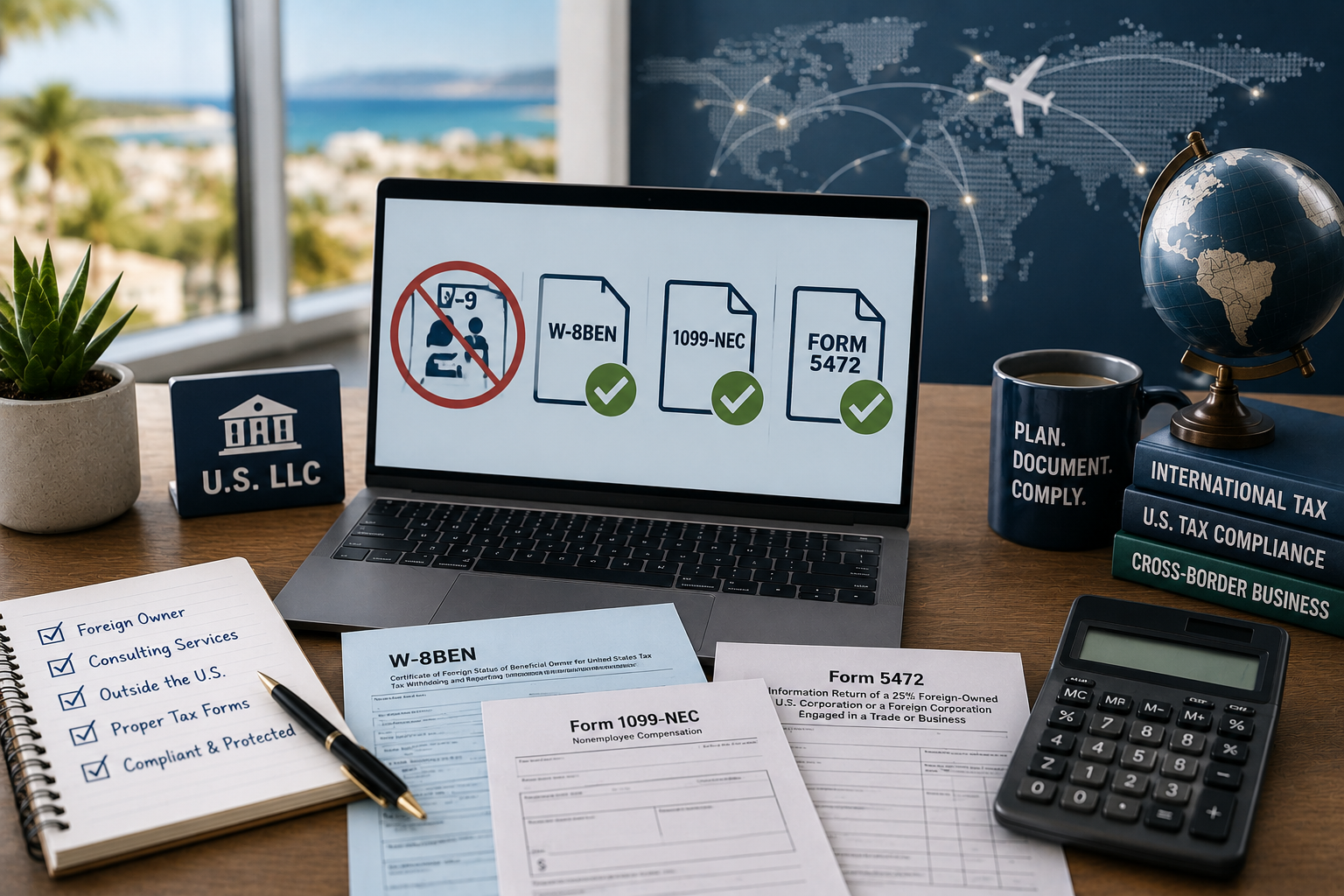
Foreign-Owned U.S. Single-Member LLC Contractors
W-9 vs. W-8BEN, Form 1099-NEC, Form 5472, and Form 1040-NR FAQ
Who This Applies To
- A non-U.S. individual owns 100% of a U.S. single-member LLC that has not elected corporate taxation.
- The owner performs consulting, technology, design, professional, digital, or similar services.
- A U.S. customer pays the LLC while the owner performs the work outside the United States.
- The customer insists on an electronic Form W-9 or has already issued Form 1099-NEC.
- The LLC had owner contributions, withdrawals, owner-paid business costs, personal costs paid by the LLC, or customer receipts deposited into a personal account.
- The owner is evaluating Form 5472, a pro forma Form 1120, Form 1040-NR, an ITIN, or a protective filing.
- In a later year, the owner enters the United States as a student, trainee, or exchange visitor and begins receiving Form W-2.
This guide assumes the LLC has one foreign owner and has not filed Form 8832 to be taxed as a corporation. Corporate elections, additional owners, product sales, U.S. employees, and U.S. offices can materially change the analysis.
Core Tax Rule in One Paragraph
Core rule
- A domestic single-member LLC is generally disregarded for federal income-tax purposes unless it elects corporate treatment. The owner is ordinarily the beneficial owner and taxpayer for the LLC’s income. Withholding documentation therefore follows the owner’s status, while Form 5472 separately treats a foreign-owned U.S. disregarded entity as a corporation only for specified information-reporting purposes. Whether the owner owes U.S. income tax depends on the source and character of the income, U.S. activities, tax residency, and any applicable treaty—not merely on the LLC’s formation state, EIN, U.S. bank account, or customer location.
Frequently Asked Questions
1. Why is Form W-9 usually wrong for a foreign owner of a disregarded LLC?
Form W-9 is a certification that the payee is a U.S. person. A foreign person generally may not provide it. A U.S.-formed LLC does not become a U.S. person for this purpose when it is disregarded and its beneficial owner is foreign.
The owner should not use the LLC’s EIN as though it were the owner’s SSN or ITIN. The EIN may identify the business or account, but it does not change the owner’s tax status.
2. Which withholding form should be provided instead?
Use the form that matches the beneficial owner and the income:
- Foreign individual owner: generally Form W-8BEN.
- Foreign corporation or other foreign entity owner: generally Form W-8BEN-E.
- Foreign person certifying that the payment is effectively connected with a U.S. trade or business: generally Form W-8ECI.
- Nonresident individual claiming a treaty exemption for certain U.S.-performed personal services: potentially Form 8233.
- Owner who has become a U.S. citizen or resident alien: generally Form W-9.
A foreign individual who is the sole owner of a disregarded LLC generally completes Form W-8BEN in the individual’s name. The LLC name or account number can be entered as reference information when payment is made to an account in the LLC’s name.
3. What should the owner do if the payer insists on Form W-9?
Respond in writing and provide the correct withholding certificate. The explanation should state that the LLC is disregarded, the beneficial owner is foreign, and Form W-9 is limited to U.S. persons. Include the relevant IRS instructions if the payer’s onboarding system does not recognize the structure.
Do not sign an inaccurate certification merely because the payer’s portal offers no alternative. A substitute electronic form must still contain the correct tax certification.
4. What if Form W-9 was already submitted or Form 1099-NEC was issued?
Correct the vendor record as soon as possible:
- Notify the payer that Form W-9 was submitted in error.
- Provide the correct Form W-8.
- Ask whether Form 1099-NEC has already been filed with the IRS.
- Request a corrected information return when the original reporting was incorrect.
- Retain the contract, invoices, payer correspondence, travel records, and evidence showing where the services were performed.
If the payer will not correct the form, the owner should report any required U.S. filing consistently with the substantive tax rules and preserve a clear written explanation. The incorrect Form 1099 creates a matching risk; it does not automatically create taxable income.
5. Does Form 1099-NEC make foreign service income taxable in the United States?
No. Form 1099-NEC reports the payer’s characterization of the payment. It does not override the source-of-income rules.
Compensation for services is generally sourced where the work is physically performed. Services performed entirely outside the United States are generally foreign-source even when the customer is American, the contract uses U.S. law, payment comes from a U.S. bank, or the money enters a U.S. LLC account.
If work was performed partly inside and partly outside the United States, the compensation generally must be allocated using workdays or another factually appropriate method.
6. Does a U.S. LLC, U.S. bank account, or U.S. customer create a U.S. trade or business?
Not by itself. The analysis focuses on actual U.S. business activity, including where services were performed, whether the owner maintained a U.S. office, whether employees or agents performed material work in the United States, and whether a U.S. representative regularly exercised meaningful contracting authority.
For a service business operated entirely from abroad by a nonresident owner, the foreign location of the work is a strong fact. The conclusion can change when the owner or another person performs services in the United States.
7. What does the foreign-owned LLC file even when the owner owes no U.S. income tax?
A foreign-owned U.S. disregarded entity commonly files Form 5472 attached to a limited pro forma Form 1120. The pro forma return is a filing cover; it is not a conventional corporate return that calculates the LLC’s business profit and corporate income tax.
Form 5472 is triggered by reportable transactions with the foreign owner or another related party. A filing can therefore be required even when the business had no U.S.-taxable income or no customer revenue.
8. Which owner transactions belong in the Form 5472 records?
Common reportable transactions include:
- Formation costs and initial funding.
- Capital contributions and owner advances.
- Cash or property distributed to the owner.
- Owner-paid LLC expenses.
- LLC-paid personal expenses.
- Loans, interest, and repayment activity between the owner and LLC.
- Customer revenue received directly in the owner’s personal account.
- Dissolution, liquidation, or transfers involving the LLC.
- Other monetary or nonmonetary transactions with related parties.
These items can be reportable even when they are not taxable income. Form 5472 is an information return, not a tax calculation.
9. How should withdrawals, direct customer receipts, and personal expenses be classified?
Trace each cash movement once from source to destination:
- Owner distribution: the customer pays the LLC, and the LLC later transfers money to the owner.
- Revenue received personally: the customer pays the owner’s personal account directly for LLC activity.
- Owner-paid company expense: the owner pays a legitimate LLC cost personally; treat it according to the records as a contribution, loan, or reimbursable advance.
- LLC-paid personal expense: the company pays the owner’s personal obligation; commonly treated as an owner distribution or another owner-related payment.
10. Can the owner call withdrawals “salary”?
Generally not when an individual owns a disregarded LLC. For federal income-tax purposes, the owner is not treated as an employee of the disregarded entity merely because cash was withdrawn. The records should distinguish distributions, reimbursements, loans, and business expenses rather than applying a payroll label that does not match the entity classification.
11. When does the foreign owner need Form 1040-NR?
Form 1040-NR may be required when the nonresident alien was engaged in a U.S. trade or business, had effectively connected income, had taxable U.S.-source income not fully satisfied through withholding, needs a refund, claims certain deductions or credits, or takes a treaty position requiring a return.
A foreign individual who performed all services abroad, had no U.S. office or material U.S. business activity, and received only foreign-source service income may have no Form 1040-NR filing requirement solely because a U.S. LLC, customer, bank account, or incorrect Form 1099 was involved.
Form 5472 and Form 1040-NR answer different questions: the first reports LLC–owner transactions; the second reports the individual’s U.S. income-tax position.
12. What is a true protective Form 1040-NR?
A true protective return is generally used when there is uncertainty whether activities in the United States constitute a U.S. trade or business or whether income is effectively connected. Filing timely can preserve the ability to claim related deductions and credits if the IRS later rejects the taxpayer’s no-USTB or no-ECI position.
An incorrect Form W-9 or a possible Form 1099 does not, by itself, create the factual predicate for a regulatory protective return. A voluntary explanatory filing may sometimes be considered for disclosure or risk management, but it should be distinguished from the formal protective-return procedure.
13. Does the owner need an ITIN for Form 5472?
Not automatically. The LLC generally needs an EIN. Form 5472 can identify the foreign owner using the owner’s foreign taxpayer identification number and, when appropriate, a consistently used reference identification number. An ITIN commonly becomes relevant when the individual must file Form 1040-NR and is not eligible for an SSN.
14. What changes when the owner later enters the United States and receives Form W-2?
Analyze the later year separately. Wages for services physically performed in the United States are generally U.S.-source and are ordinarily reported on Form W-2. The LLC activity must be reviewed independently to determine whether any services were performed through the LLC while the owner was in the United States.
Immigration authorization and taxability are separate questions. A payment can be taxable even when the underlying activity raises a visa-compliance issue, and lawful employment authorization does not itself determine tax residency.
15. Does 183 days in the United States automatically make a J-1 visitor a resident alien?
No. The substantial presence test uses a weighted three-year formula, and certain J-1 days may be excluded while the individual qualifies as an “exempt individual.” The rules differ for students and for teachers or trainees and depend on prior calendar years in exempt status.
“Exempt individual” means exempt from counting days for this residency test; it does not mean exempt from U.S. tax. Form 8843 is generally required to claim the excluded-day treatment.
16. How do citizenship, foreign residence, and tax treaties interact?
Treaty eligibility generally follows treaty residence under the applicable treaty, not citizenship alone, a former mailing address, or a statement that another country is “home.” A citizen of one country who previously lived in another must establish residence under the treaty for the specific year and income item.
The analysis may require the treaty residence article, the income article, any limitation-on-benefits or saving-clause rules, and possible Form 8833 disclosure. A prior Canadian residence, for example, does not automatically create Canadian treaty protection after the person moves to the United States.
Common Mistakes
Signing Form W-9 because the LLC is formed in the US
Fix: Determine the beneficial owner’s status and use the appropriate W-8 unless the payee is actually a U.S. person.
Using the LLC EIN as the owner’s personal tax number
Fix: Keep the LLC EIN, foreign TIN, reference ID, ITIN, and SSN roles separate.
Assuming Form 1099 automatically creates U.S. tax
Fix: Apply the source-of-services and U.S.-activity rules, then request a corrected information return when appropriate.
Assuming no Form 1099 means no filing obligation
Fix: Form 5472 may still be required for contributions, distributions, formation costs, loans, or other related-party transactions.
Treating the pro forma Form 1120 as a corporate income-tax return
Fix: Analyze the foreign owner’s personal U.S. tax position separately from the LLC’s information return.
Applying a simple 183-day rule to J-1 status
Fix: Determine the J-1 category, prior exempt years, Form 8843 requirement, and weighted substantial-presence calculation.
Deadlines and Penalty Exposure
Form 5472 and the pro forma Form 1120
A calendar-year foreign-owned disregarded entity generally files by April 15. Form 7004 can extend the filing deadline when submitted timely under the special filing instructions for foreign-owned U.S. disregarded entities.
The initial penalty for failing to file a complete Form 5472 is $25,000. If the failure continues for more than 90 days after IRS notice, additional $25,000 penalties can apply for each 30-day period or part of a period. A substantially incomplete form can be treated as a failure to file.
Form 1040-NR
A calendar-year nonresident who received wages subject to U.S. withholding generally files by April 15. A nonresident without such wages generally files by June 15. An extension extends filing time, not the payment deadline.
When deductions or credits depend on effectively connected income, an untimely return can jeopardize the ability to claim them. That is the principal purpose of a timely protective return when U.S. business status is genuinely uncertain.
Incorrect Form 1099
The payer should correct an erroneous information return. The recipient should preserve the incorrect form, correction request, proper Form W-8, payer correspondence, contract, invoices, work-location evidence, and corrected form if issued.
Practical Examples
Example 1: All consulting services performed from Canada
A foreign individual owns a Wyoming single-member LLC and performs every service from Canada for a U.S. customer. The customer requests Form W-9 because the LLC has a U.S. EIN.
- The foreign individual is generally the beneficial owner for federal withholding documentation.
- Form W-8BEN is generally more appropriate than Form W-9.
- The service income is generally foreign-source because the work occurred outside the United States.
- The LLC may still file Form 5472 and a pro forma Form 1120 for owner transactions.
- Form 1040-NR is not automatically required solely because the customer is from US and LLC is formed in the US.
Example 2: Form 1099-NEC issued after an incorrect W-9
The payer reports $80,000 on Form 1099-NEC using the LLC’s EIN. The owner performed all services abroad.
- Provide the correct Form W-8BEN and request a corrected Form 1099-NEC.
- Document the owner’s physical work location and travel days.
- Evaluate Form 1040-NR based on actual U.S. activities and income—not merely the information return.
- Retain an explanation in case the IRS matching system generates a notice.
Example 3: Owner contributions, withdrawals, and personal costs
During one year, the owner contributes $10,000, personally pays $1,500 of LLC expenses, withdraws $25,000, and has the LLC pay $2,000 of personal costs.
- $11,500 may be tracked as contributions or owner advances, depending on the records.
- $25,000 is generally tracked as an owner distribution.
- $2,000 of personal costs is generally an additional owner-related payment unless already included in the distribution total.
Example 4: J-1 practical training begins the following year
The owner later enters the United States, performs authorized training, and receives Form W-2. The earlier foreign-service year remains separate. In the later year, U.S. wages are generally reportable, Form 8843 may be required, tax residency depends on the J-1 category and prior exempt years, and any LLC work performed while physically in the United States must be reanalyzed.
Closing
Form W-9, the W-8 series, Form 1099-NEC, Form 5472, and Form 1040-NR serve different functions. The correct withholding form follows the beneficial owner’s status. Taxability follows income sourcing, U.S. activity, residency, and treaty rules. Form 5472 separately reports transactions between the foreign owner and the U.S. disregarded entity.
Central principle
- Use the withholding form that matches the beneficial owner’s actual status, source service income where the work was performed, report LLC–owner transactions once and accurately, and reassess each later tax year when the owner begins working or residing in the United States.
IRS-Grounded Source Notes
The following authorities support the principal federal tax rules summarized in this guide. Links point to official IRS materials current as of July 2026. The form year shown in an IRS title may be the most recent published revision even when the underlying rule continues to apply.
1. Single-member LLC classification
A domestic LLC with one owner is generally disregarded for federal income-tax purposes unless it elects corporate treatment. IRS — Single Member Limited Liability Companies
2. Identifying the payee of a disregarded entity
For payments to a disregarded entity, the owner is generally treated as the payee. IRS — Identifying the Payee
3. Form W-9 is for U.S. persons
The requester instructions state that a foreign person may not provide Form W-9. IRS — Instructions for the Requester of Form W-9
4. Foreign individual owner and Form W-8BEN
The foreign individual single owner of a disregarded entity generally completes Form W-8BEN in the owner’s name and may identify the disregarded entity on line 7. IRS — Instructions for Form W-8BEN
5. Service-income sourcing
Personal service income is generally sourced where the services are physically performed; mixed-location services generally require allocation. IRS — Source of Income: Personal Service Income
6. Withholding and foreign payee documentation
Publication 515 discusses Forms W-8, Form W-9, foreign payees, service income, and withholding-agent responsibilities. IRS — Publication 515 (2026)
7. Foreign-owned U.S. disregarded entities and Form 5472
The instructions cover the limited corporate treatment, reportable owner transactions, pro forma Form 1120, special filing procedures, extensions, and $25,000 penalty. IRS — Instructions for Form 5472
8. Form 1040-NR filing requirements and deadlines
The instructions describe who must file, April and June deadlines, ECI reporting, treaty information, and protective-return references. IRS — Instructions for Form 1040-NR
9. Correcting information returns
The general instructions explain how payers correct Forms 1099 and other information returns. IRS — Publication 1099 (2026)
10. Substantial presence test
Tax residency uses a weighted three-year day-counting formula, with exclusions for qualifying exempt individuals. IRS — Substantial Presence Test
11. J-1 taxation and exempt-individual rules
The IRS explains that J-1 status can exclude certain days from the residency calculation but does not itself exempt income from tax. IRS — Taxation of Alien Individuals by Immigration Status: J-1
12. Student exempt-individual limit and Form 8843
The IRS explains the five-calendar-year student rule, fact-sensitive exceptions, and Form 8843 filing requirement. IRS — Exempt Individual: Who Is a Student
Professional-Use Disclaimer
This article is provided for educational purposes and presents a simplified overview of federal tax classification, withholding documentation, information reporting, income sourcing, nonresident filing, and tax-residency rules. The correct treatment depends on the LLC’s federal classification, the beneficial owner’s citizenship and tax residency, where services are physically performed, the payer’s reporting, U.S. business activities, related-party transactions, immigration status, treaty eligibility, and the applicable tax year.
Forms W-9, W-8BEN, W-8BEN-E, W-8ECI, 1099-NEC, 5472, the pro forma Form 1120, and Form 1040-NR serve different purposes and should not be used interchangeably. An incorrectly issued information return does not, by itself, determine whether income is taxable, but it can create IRS matching issues that should be addressed promptly and consistently.
For a fact-specific review of your foreign-owned U.S. LLC, withholding documentation, Form 1099 correction, Form 5472 and pro forma Form 1120 obligations, Form 1040-NR exposure, ITIN requirements, treaty position, or later U.S. residency issues, book a paid consultation with our firm.
***Disclaimer: This communication is not intended as tax advice, and no tax accountant/Attorney client relationship results**