
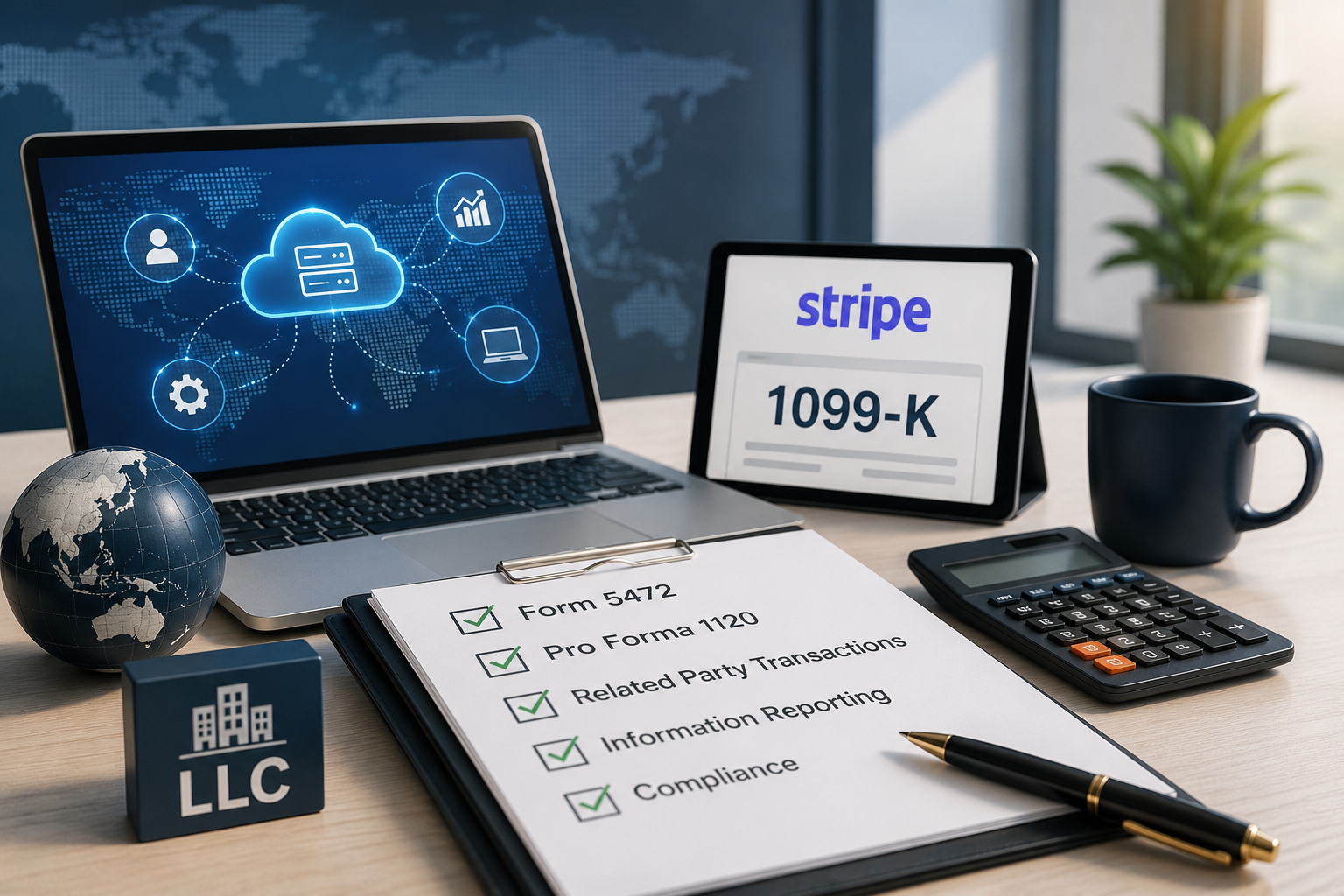
Form 5472, Pro Forma Form 1120, and Stripe Form 1099-K for Foreign-Owned SaaS LLCs
A practical FAQ for non-U.S. founders operating software, cloud, marketplace, and digital-platform businesses through U.S. single-member LLCs
By Alex Oware, CPA and Tax Attorney
|
Information reporting • related parties • payment-processor reconciliation • SaaS characterization • U.S. trade or business |
|---|
Who This Applies To
A nonresident alien owns 100% of a domestic single-member LLC.
The LLC has not filed Form 8832 to elect corporate treatment and has not added a second member.
The business provides hosted software, subscriptions, transaction facilitation, digital wish-list functions, or another online platform.
Stripe or another processor issued Form 1099-K to the LLC or owner.
The platform may receive customer funds, retain a fee, and transfer the balance to creators or other users.
The owner manages the business from outside the United States and is evaluating Form 5472, pro forma Form 1120, and Form 1040-NR.
Scope limitation. This article does not address a partnership, an LLC taxed as a corporation, a U.S. C corporation, or a foreign corporation. Those structures use different filing and income-tax rules.
Core Tax Rule in One Paragraph
|
Core Rule A domestic single-member LLC is generally disregarded from its owner for federal income-tax purposes unless it elects corporate treatment. A special rule nevertheless treats a wholly foreign-owned U.S. disregarded entity as a separate corporation for the limited Form 5472 recordkeeping and reporting regime. The LLC may therefore have to file Form 5472 with a pro forma Form 1120 even when the foreign owner owes no U.S. federal income tax. The owner’s income-tax filing is analyzed separately under the source-of-income, U.S.-trade-or-business, effectively connected income, and withholding rules. |
|---|
Source notes: SN-1, SN-2, SN-10
Frequently Asked Questions
1. What does a foreign-owned single-member LLC generally file?
If the LLC had a reportable transaction with a related party, it generally files Form 5472 attached to a limited pro forma Form 1120. The pro forma return is the filing vehicle; it is not a complete corporate income-tax return.
The LLC generally uses its owner’s U.S. tax year or, if the owner has no U.S. tax year, the calendar year. The package is filed using the special fax or mailing procedure in the Form 5472 instructions and is not electronically filed by a foreign-owned U.S. disregarded entity.
Source notes: SN-1, SN-2
2. What is a related party, and why can another related party require more work?
The foreign owner is a related party. The definition can also reach another company under common ownership or control, certain family-related entities, and persons related under the sections 267, 707, 318, or 482 rules.
The IRS generally requires a separate Form 5472 for each foreign or U.S. related party with which the LLC had a reportable transaction. An additional preparation charge commonly reflects the separate identification, ownership analysis, transaction reconciliation, and form required for that party. It is not an additional IRS filing fee.
Source notes: SN-1
3. Which transactions with the foreign owner are commonly reportable?
For a foreign-owned U.S. disregarded entity, Part V can capture transactions that would otherwise be disregarded for federal income-tax purposes. The review ordinarily includes:
Cash contributed by the owner and cash distributed to the owner.
Loans, repayments, interest, and balances due to or from the owner.
Formation, acquisition, disposition, and dissolution transactions.
LLC expenses paid personally by the owner and reimbursements to the owner.
Property, services, or rights transferred for no consideration or less than full consideration.
Payments involving another commonly controlled business.
Source notes: SN-1
An LLC can therefore have a Form 5472 filing obligation even when it has no customers, no profit, or no U.S. income-tax liability.
4. Does receiving Form 1099-K from Stripe mean the amount is taxable in the United States?
No. Form 1099-K is a gross-payment information statement. It does not decide the recipient’s tax residency, income source, U.S. trade or business, effectively connected income, or actual net revenue.
The form is evidence that payments were processed and must be reconciled. The tax result follows from the underlying transactions and the recipient’s records, not from the existence of the form alone.
Source notes: SN-3
5. What amount does Form 1099-K report, and how should it be reconciled?
Box 1a generally reports gross payment-card and third-party-network transactions. The number is not reduced for processor fees, refunds, credits, discounts, chargebacks, shipping, or cash-equivalent adjustments.
Reconcile the annual form to Stripe’s monthly activity, bank deposits, refunds, disputed transactions, processor fees, and payouts to creators or users. Any difference between gross processed payments and accounting revenue should be traceable and documented.
Source notes: SN-3
6. If the platform collects money for users and keeps only a fee, is only the fee revenue?
Possibly, but not merely because the platform transfers most of the money to someone else. The accounting result turns on whether the platform is the principal in the customer transaction or an agent collecting funds for another person.
Relevant facts include who promises the underlying product or service, controls pricing, bears refund and fraud risk, is identified as the seller, has discretion over fulfillment, and is legally entitled to the customer payment. The terms of service, creator agreement, Stripe configuration, and flow of funds should all agree with the accounting treatment.
Source notes: SN-3
7. Is SaaS automatically treated as service income?
A qualifying cloud transaction is classified as the provision of services under Treasury Regulation section 1.861-19 for the international tax provisions listed in that regulation. The rule applies to on-demand network access to computer hardware, digital content, or similar resources and includes examples involving hosted software and software-as-a-service resellers.
That does not mean every online platform is a cloud transaction. A marketplace, payment-facilitation arrangement, downloadable software transfer, digital-content license, advertising arrangement, or mixed transaction must be characterized from the customer’s primary benefit and the contractual rights provided.
Source notes: SN-6
8. Where is SaaS or cloud income sourced for U.S. tax purposes?
The general Code rule sources services according to where the services are performed. For traditional personal services, physical work location is commonly decisive.
Automated cloud services present a harder question because personnel, proprietary software, and server infrastructure may all contribute to performance. Treasury and the IRS issued proposed cloud-source regulations using intangible-property, personnel, and tangible-property factors. As of July 26, 2026, those source rules remained proposed rather than final.
Accordingly, a statement that all SaaS income is foreign-source merely because the owner sits outside the United States is too broad. A defensible analysis should identify where key personnel work, where the relevant intellectual property was developed and is owned, where supporting servers or infrastructure are located, and what the customer actually receives.
Source notes: SN-4, SN-5, SN-6
9. Does operating from abroad guarantee that the owner owes no U.S. federal income tax?
No. Operating abroad is an important fact, but the result also depends on income characterization, source, and whether the owner is engaged in a U.S. trade or business.
Potentially adverse facts include U.S. workdays, employees performing core functions, a U.S. office, a dependent agent negotiating or concluding contracts, U.S.-used intellectual property, or cloud infrastructure that materially contributes to U.S.-source income. Certain U.S.-source income can also be taxed or withheld even when it is not effectively connected income.
Source notes: SN-4, SN-7, SN-8
10. Do a U.S. LLC, U.S. customers, Stripe, or a U.S. bank account create a U.S. trade or business by themselves?
Generally, no single one of those facts is conclusive. Formation, banking, and payment processing are organizational or financial facts; the U.S.-trade-or-business inquiry focuses on the nature, regularity, and location of substantive business activities.
The same caution applies in reverse. The absence of a leased office does not prove that no U.S. trade or business exists when employees, contractors, agents, or the owner perform meaningful business functions in the United States.
Source notes: SN-7, SN-8
11. When might the foreign individual owner need Form 1040-NR?
A nonresident alien generally files Form 1040-NR when engaged in a U.S. trade or business during the year. The filing requirement can apply even when no tax is ultimately due or a treaty position eliminates the tax.
A nonresident who is not engaged in a U.S. trade or business may also need to file when U.S.-source income was not fully taxed through withholding or to claim a refund. If the disregarded LLC produces effectively connected sole-proprietor income, the owner commonly reports the business on Form 1040-NR with Schedule C.
Source notes: SN-7
12. Is the pro forma Form 1120 the LLC’s income-tax return?
No. The foreign-owned U.S. disregarded entity completes only the limited identifying information required by the Form 5472 instructions and writes “Foreign-owned U.S. DE” across the top.
The pro forma filing does not elect C corporation status, report the full profit and loss, calculate the foreign owner’s federal income tax, or replace Form 1040-NR when the owner has an income-tax filing obligation.
Source notes: SN-1, SN-2
13. Does Form 5472 report Stripe customer payments?
Not merely because Stripe processed them. Form 5472 reports transactions with related parties. Stripe and unrelated customers are ordinarily not related parties.
The customer receipts and Stripe fees belong in the bookkeeping and income-tax analysis. Owner contributions, distributions, related-party loans, reimbursements, services, and transfers belong in the Form 5472 review.
Source notes: SN-1
14. What should be done when Form 1099-K appears incorrect?
Compare the legal name, taxpayer identification number, gross amount, monthly totals, refunds, chargebacks, and duplicate accounts to the processor’s records. Contact the processor for a corrected form when the payee or gross amount is wrong.
Form 1099-K is generally retained with the records rather than attached to the pro forma Form 1120. The reconciliation should be preserved in case the IRS later matches the information form to an owner-level return or requests an explanation.
Source notes: SN-3
15. Can state or sales-tax obligations apply when no federal income tax is due?
Yes. Federal income tax, Form 5472 information reporting, state annual or franchise obligations, and sales or transaction taxes are separate systems.
A state may impose annual fees because the LLC was formed there. Other states may assert income, gross-receipts, or sales-tax nexus based on customers, employees, contractors, transaction volume, or marketplace activity. The taxable treatment of hosted software and digital services also varies by state.
16. What records should the LLC retain?
The compliance file should permit a reviewer to reconstruct ownership, related-party transactions, payment processing, revenue, and operating location.
Formation documents, EIN notice, ownership chart, and any Form 8832 election.
Terms of service, creator or user agreements, refund policy, and intellectual-property terms.
Stripe statements, Form 1099-K, bank statements, refunds, chargebacks, fees, and user payouts.
A gross-to-net revenue reconciliation and principal-versus-agent memorandum.
Owner contributions, distributions, loans, reimbursements, and owner-paid expenses.
Invoices and agreements with foreign or U.S. related companies.
Work-location records for the owner and key personnel, server or hosting details, and IP-development records.
State registrations, annual filings, and sales-tax records.
Source notes: SN-1, SN-3
Common Mistakes
Mistake 1: Treating Form 1099-K as a tax bill.
Fix: Reconcile gross processed payments to actual revenue, refunds, fees, and user payouts.
Mistake 2: Assuming the owner is the only possible related party.
Fix: Prepare an ownership and control chart for every company or LLC that transacted with the U.S. entity.
Mistake 3: Reporting only owner withdrawals on Form 5472.
Fix: Review contributions, owner-paid expenses, loans, reimbursements, property transfers, and formation activity.
Mistake 4: Treating every online platform as ordinary personal services.
Fix: Apply the cloud, digital-content, marketplace, licensing, and principal-versus-agent rules to the actual contract.
Mistake 5: Sourcing all SaaS income solely to the owner’s desk location.
Fix: Analyze personnel, intellectual property, infrastructure, and the current status of the proposed cloud-source regulations.
Mistake 6: Assuming no office means no U.S. trade or business.
Fix: Review U.S. workdays, employees, contractors, agents, and other substantive U.S. functions.
Forms and Filing Checklist
|
Form or record |
Why it matters / who handles it |
General deadline |
Key inputs |
|---|---|---|---|
|
Form 5472 |
Reports qualifying transactions between the foreign-owned U.S. DE and each related party. |
With pro forma Form 1120; calendar-year package generally due April 15. |
Owner and related-party data; contributions; distributions; loans; services; nonmonetary transfers. |
|
Pro forma Form 1120 |
Limited cover return for the foreign-owned U.S. DE; not the owner’s income-tax return. |
Same due date as Form 1120, including a timely extension. |
LLC name, address, EIN, tax year, and limited page-one items. |
|
Form 7004 |
Extends the Form 5472/pro forma Form 1120 filing deadline. |
Original due date; generally a six-month extension if timely filed. |
LLC identifying information and Form 1120 return code. |
|
Form 1040-NR |
Owner-level return when the nonresident alien has a U.S. trade or business or another filing trigger. |
Generally April 15 with wages subject to withholding; otherwise generally June 15. |
U.S. activities, source analysis, ECI, deductions, withholding, and treaty positions. |
|
Schedule C |
Reports effectively connected sole-proprietor business income when required with Form 1040-NR. |
With Form 1040-NR. |
Gross receipts, refunds, processor fees, user payouts, operating expenses, and assets. |
|
Form 1099-K reconciliation |
Not filed by the recipient; supports the amount treated as revenue and explains gross-to-net differences. |
Prepared with the annual books and retained with records. |
Processor totals, refunds, chargebacks, fees, user payouts, corrected forms, and bank deposits. |
Deadlines and Penalty Exposure
|
Do not merge the filing systems Form 5472, Form 1040-NR, state annual reports, and sales-tax filings have separate due dates. Filing one return does not satisfy or extend the others. |
|---|
Form 5472 and pro forma Form 1120: a calendar-year foreign-owned U.S. disregarded entity generally files by April 15. A timely Form 7004 generally extends the filing deadline by six months.
Filing method: the foreign-owned U.S. disregarded entity uses the dedicated Form 5472 fax or mailing instructions and cannot electronically file this package.
Initial Form 5472 penalty: generally $25,000 for failure to file correctly and on time or failure to maintain required records. A substantially incomplete form can be treated as a failure to file.
Continuation penalties: additional $25,000 penalties can apply after IRS notice when the failure continues beyond the statutory 90-day period, with further penalties for each subsequent 30-day period or fraction.
Form 1040-NR: a separate late-filing, late-payment, and interest analysis applies when the owner had an income-tax filing obligation.
Source notes: SN-1, SN-7, SN-9
Practical Examples
Example 1: One foreign owner, no U.S. personnel, and a Stripe Form 1099-K
A nonresident individual owns a single-member LLC and operates a hosted subscription platform from outside the United States. The owner contributes cash, pays some LLC expenses personally, and receives distributions. Stripe issues Form 1099-K.
The LLC evaluates and generally files Form 5472 with a pro forma Form 1120 for the owner transactions.
The Form 1099-K is reconciled but is not itself entered on Form 5472.
The platform is characterized under the cloud and digital-transaction rules.
The owner separately evaluates source, U.S.-trade-or-business status, and Form 1040-NR.
Example 2: The platform processes user funds and retains a commission
A platform processes $1,000,000 through Stripe, transfers $900,000 to users, and retains $100,000. The Form 1099-K reports the gross processed amount.
The platform must preserve the entire reconciliation and support its principal-versus-agent conclusion. If the contracts and risk allocation show that the platform acts only as an agent, the retained fee may be the appropriate revenue amount. The Form 1099-K does not decide that issue.
Example 3: A related foreign development company charges the LLC
The owner also controls a foreign software-development company that invoices the U.S. LLC. The U.S. LLC may now have two related parties: the owner and the development company. A separate Form 5472 may be required for each.
Example 4: The platform uses U.S. personnel and U.S. servers
The owner remains abroad, but U.S. contractors perform core product development and customer operations, and the platform relies on U.S.-located infrastructure. Those facts require a new source and U.S.-trade-or-business analysis. The owner’s physical location alone is no longer an adequate basis for concluding that all income is foreign-source.
Closing
A foreign-owned SaaS LLC can have mandatory U.S. information reporting even when its foreign owner owes no U.S. federal income tax. Form 5472 and the pro forma Form 1120 document the LLC’s related-party activity. Form 1099-K documents gross processed payments. Form 1040-NR addresses the owner’s separate U.S. income-tax position.
The analysis should proceed in sequence: confirm entity classification, identify every related party, reconstruct related-party transactions, reconcile Form 1099-K, characterize the platform’s receipts, determine the applicable source rule, evaluate U.S. business activity, and review state obligations separately.
|
Final Takeaway Do not use Form 1099-K as the taxable-income answer, do not use Form 5472 as the income-tax return, and do not treat the owner’s foreign location as the sole sourcing rule for an automated SaaS or cloud platform. |
|---|
IRS-Grounded Source Notes
These notes identify the official federal materials supporting the revised analysis. “Current” references reflect materials available through July 26, 2026.
SN-1. IRS Instructions for Form 5472.
Definitions, separate-form requirement, special DE filing method, records, and the $25,000 penalty framework. Official source
SN-2. IRS Instructions for Form 1120.
Limited-purpose corporate treatment and the pro forma Form 1120 attachment rule. Official source
SN-3. IRS, What to Do With Form 1099-K; Instructions for Form 1099-K.
Gross, unadjusted reporting and the rule that a reported payment is not automatically taxable income. Official source
SN-4. IRS, Nonresident Aliens – Sourcing of Income.
Source factors for services, royalties, rents, sales, interest, and other income. Official source
SN-5. IRS, Source of Income – Personal Service Income.
Traditional physical-performance rule and time-based allocation for mixed-location services. Official source
SN-6. T.D. 10022 and REG-107420-24, Internal Revenue Bulletin 2025-08.
Final section 1.861-19 classifies qualifying cloud transactions as services. Companion source rules using IP, personnel, and tangible-property factors remained proposed through July 26, 2026. Official source
SN-7. IRS Instructions for Form 1040-NR.
Owner-level filing triggers and general deadlines for nonresident aliens. Official source
SN-8. IRS Publication 515, Withholding of Tax on Nonresident Aliens and Foreign Entities.
U.S.-source FDAP, service sourcing, withholding, and ECI payment rules. Official source
SN-9. IRS Form 7004 guidance.
Automatic extension procedure when filed by the original due date. Official source
SN-10. IRS, Single-Member Limited Liability Companies.
Default disregarded status unless corporate treatment is elected. Official source
|
Professional-Use Disclaimer This article is provided for educational purposes and offers a simplified overview of federal international tax, entity-classification, withholding, and information-reporting rules. The correct treatment depends on the specific contracts, ownership structure, payment flows, intellectual-property rights, locations of personnel and infrastructure, tax residency, state nexus, and the applicable tax year. Form 5472 carries significant penalty exposure, and the federal sourcing rules for SaaS, cloud transactions, and digital platforms continue to evolve. For a fact-specific review of your foreign-owned LLC, Form 5472 and pro forma Form 1120 obligations, Stripe Form 1099-K reconciliation, related-party transactions, SaaS income sourcing, and possible Form 1040-NR exposure, book a paid consultation with our firm. |
|---|
***Disclaimer: This communication is not intended as tax advice, and no tax accountant/Attorney client relationship results**