
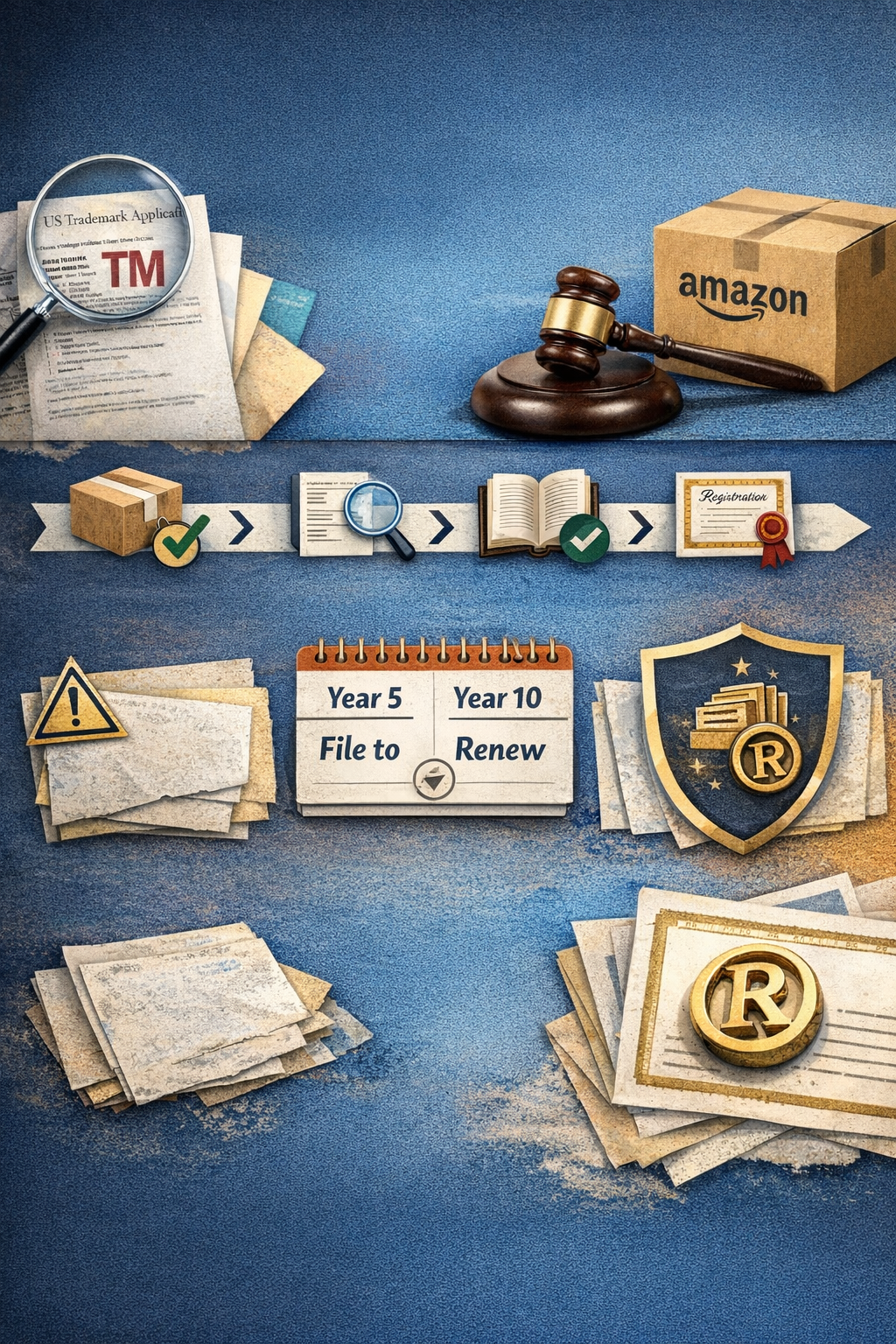
Guía del vendedor de Amazon para el registro de marcas en EE. UU.: desde la presentación de la Sección 1(a) hasta el registro de la marca
PARTE I
Introducción
Si vende en Amazon y desea un registro de marca, necesita una marca registrada.
Pero la mayoría de los vendedores no entienden realmente cómo funciona el proceso de marca registrada en Estados Unidos.
Ellos piensan:
- “Ya presenté la solicitud. Ahora espero.”
- “Tarda 12 meses.”
- “Una vez que presento la solicitud, estoy protegido”.”
- “Amazon se encargará de ello”.”
Nada de esto es completamente exacto.
En este artículo, lo guiaré a través del proceso real, paso a paso, utilizando una presentación de uso en el comercio real (que es lo que se aplica cuando ya está vendiendo su producto antes de la presentación).
Esta es la secuencia exacta que debes esperar.
________________________________________
Paso 1: ¿Estás realmente utilizando la marca?
Antes de presentar cualquier solicitud, hago una pregunta sencilla:
¿Está realmente tu marca en el producto?
Para bienes físicos, eso significa:
- Sobre el producto en sí
- En el embalaje
- En una etiqueta adherida al producto
Un listado de Amazon por sí solo no es suficiente.
La ley exige que la marca se utilice en los productos en el comercio, no sólo en la publicidad.
Si ya está vendiendo su producto con su marca físicamente en él, podemos archivarlo en:
Sección 1(a) — Uso en el comercio
Este es el camino más rápido.
________________________________________
Paso 2: Presentar la solicitud
Una vez que confirmamos el uso correcto, presentamos la solicitud.
Esto es lo que sucede el día de la presentación:
- Seleccionamos la clase correcta (por ejemplo, Clase 21 para artículos para el hogar).
- Elegimos Registro Principal.
- Registramos el documento como una marca de carácter estándar (si solo se protege el texto).
- Adjuntamos ejemplar correspondiente.
- Reclamamos la fecha de primer uso correcta.
- Nosotros pagamos la tasa de presentación.
La fecha de presentación se vuelve extremadamente importante.
Esa fecha le otorga prioridad a nivel nacional, incluso antes del registro.
Esto significa que si alguien adopta la misma marca más adelante, su fecha de presentación lo protege.
________________________________________
Paso 3: ¿Qué sucede después de la presentación?
Después de presentar la solicitud, recibirá un número de serie.
En esta etapa:
- Su solicitud está pendiente.
- Amazon podría permitir el acceso al Registro de Marcas.
- Pero aún no estás registrado.
Ahora la aplicación espera.
Actualmente, la USPTO suele tardar entre 4 y 7 meses antes de que un examinador lo revise.
Este período de espera es normal.
No pasa nada malo.
________________________________________
Paso 4: La revisión del examinador (lo que los vendedores no ven)
Cuando su solicitud se asigna a un examinador, ocurren varias cosas detrás de escena:
- 1. Buscan en la base de datos federal de marcas.
- 2. Buscan en Google.
- 3. Buscan marcas similares.
- 4. Comprueban si tu nombre es descriptivo.
- 5. Revisan tu muestra.
- 6. Comprueban si sus mercancías están correctamente clasificadas.
Si hay algún problema recibirás una Acción de Oficina.
Si todo está limpio, el examinador lo aprueba para su publicación.
La mayoría de los vendedores piensan que la aprobación significa registro.
No lo hace.
Esto significa que el gobierno ha terminado de revisar el asunto, pero el público tiene la oportunidad de objetar.
PARTE II
Publicación, oposición, registro y lo que realmente significa para su marca en Amazon
________________________________________
Paso 5: Publicación — El período de impugnación pública
Una vez que el examinador aprueba su solicitud, su marca queda programada para su publicación en algo llamado Boletín Oficial de Marcas.
Esta es simplemente una lista pública de marcas comerciales recientemente aprobadas.
¿Por qué esto importa?
Porque durante 30 días después de la publicación, cualquier persona que considere que su marca podría perjudicar su marca puede presentar una oposición.
Esto no es común para la mayoría de los vendedores de marcas privadas de Amazon, pero es posible.
Durante este período de 30 días:
- Un competidor puede presentar una objeción formal.
- Pueden solicitar tiempo adicional para investigar.
- El asunto puede convertirse en una disputa legal ante la Junta de Juicios y Apelaciones de Marcas (TTAB).
Si eso sucede, se convierte en un asunto de litigio.
Pero en la mayoría de las situaciones normales de la marca Amazon, si su nombre fue limpiado adecuadamente antes de presentar la solicitud, nadie se opone.
Si nadie se opone dentro de 30 días, la solicitud pasa automáticamente al registro.
________________________________________
Paso 6: Registro
Si no se presenta ninguna oposición, la USPTO emite su certificado de registro.
Para una presentación de uso comercial (que se aplica cuando ya estaba vendiendo antes de la presentación):
- No hay ningún papeleo adicional.
- No hay ninguna tarifa gubernamental adicional.
- No es necesario que envíes nada más.
El registro suele emitirse entre 7 y 11 semanas después de la publicación.
En ese momento:
- Recibirás un número de registro.
- Puedes utilizar legalmente el símbolo ®.
- Su marca está oficialmente en el Registro Principal.
Este es el punto en el que su marca se convierte en una marca registrada a nivel federal.
________________________________________
Lo que realmente te ofrece el registro
Simplifiquemos lo que realmente significa el registro:
- 1. Protección nacional
Incluso si sólo vende en Amazon, su registro le otorga derechos a nivel nacional.
- 2. Presunción legal
La ley ahora presume:
- Eres dueño de la marca.
- Es válido.
- Tienes el derecho exclusivo de usarlo en relación con tus productos listados.
- 3. Mayor cumplimiento de las normas de Amazon
El Registro de Marca se fortalece una vez emitido el registro.
Ayuda con solicitudes pendientes.
Las marcas registradas tienen mayor peso en situaciones de cumplimiento.
- 4. Acceso a la Corte Federal
Si alguien copia su marca, ahora tiene acceso a recursos judiciales federales.
________________________________________
Paso 7: La parte más olvidada: el mantenimiento
Muchos vendedores piensan que el registro dura para siempre.
No lo hace.
Debes mantenerlo.
Aquí está la versión simple:
Entre el año 5 y 6
Debe presentar una Declaración de Uso.
Si no lo hace, su registro será cancelado.
Entre el año 9 y 10
Debes presentar:
- Declaración de uso
- Renovación
Después de esto, se renueva cada 10 años.
El no cumplir con estos plazos cancelará automáticamente su inscripción.
No hay recordatorios más allá de los correos electrónicos de cortesía.
Aquí es donde tener un abogado es importante.
________________________________________
¿Qué podría salir mal?
Seamos realistas.
Estos son los problemas más comunes que enfrentan los vendedores de Amazon:
- 1. Nombres de marca descriptivos
Si su marca describe su producto demasiado claramente, la USPTO puede rechazarlo.
Ejemplo:
- “Cestas de Bambú Premium” para cestas de bambú.
Eso es descriptivo.
- 2. Marca existente similar
Si alguien ya registró algo confusamente similar, recibirá un rechazo.
Por eso es importante obtener una autorización antes de presentar la solicitud.
- 3. Muestra inadecuada
Si su marca no aparece correctamente en el producto o en el embalaje, es posible que reciba una Acción de Oficina.
Muchos vendedores de Amazon envían:
- Maquetas editadas
- superposiciones digitales
- Imágenes de producto incompletas
Esto puede causar retrasos.
________________________________________
¿Cuánto tiempo debe esperar que tome el proceso?
Si todo está limpio:
- Presentación hasta registro: alrededor de 8 a 10 meses.
Si hay una Acción de Oficina:
- Añadir de 2 a 6 meses.
Si hay oposición:
- Puede tomar entre 1 y 2 años.
Gestionar las expectativas es fundamental.
Esto no es instantáneo.
Es un proceso legal.
________________________________________
Reflexiones finales para los vendedores de Amazon
Si ya está vendiendo su producto antes de presentar la solicitud:
- Presentar el expediente según la Sección 1(a).
- Asegúrese de que su marca esté físicamente en los productos.
- Asegúrese de que su nombre no sea descriptivo.
- Limpiar la marca antes de archivar.
- Entienda que la publicación no es un registro.
- Comprenda que el registro requiere mantenimiento.
Una marca no es sólo papeleo.
Es la base legal de tu marca.
Si construye su negocio en Amazon sobre una marca débil o desprotegida, está construyendo sobre terreno inestable.
Trabaje con un abogado que entienda el proceso
El registro de una marca no es simplemente el envío de un formulario.
Es un proceso legal con secuencia, plazos, decisiones estratégicas y consecuencias a largo plazo.
Para los vendedores de Amazon, los errores al principio pueden costar:
- Retrasos de varios meses
- Acciones de oficina y cargos adicionales
- Registros débiles o inaplicables
- Costos de cambio de marca
- Pérdida de acceso al Registro de Marcas
Guío a los vendedores a través del proceso de principio a fin:
- Autorización adecuada antes de presentar la solicitud
- Selección correcta de la base de presentación
- Revisión de muestras y cumplimiento
- Selección estratégica de clases
- Respuesta de la Oficina (si es necesario)
- Monitoreo de publicaciones
- Planificación del mantenimiento posterior al registro
Si ya está vendiendo su producto y desea proteger su marca adecuadamente, el objetivo no es solo “presentar la solicitud”; el objetivo es asegurar una protección federal exigible que respalde su negocio en Amazon a largo plazo.
Puedes contactarme a través de:
Servicios de impuestos y contabilidad de O & G, LLC
o
Defensores de la justicia de Oware
Ya sea que esté lanzando su primer producto de marca privada o expandiendo una cartera de marca establecida, puedo ayudarlo a proteger lo que está construyendo.
Su marca merece más que un servicio de archivo.
Merece una protección jurídica adecuada.
***Descargo de responsabilidad: Esta comunicación no pretende ser asesoramiento fiscal y no genera ninguna relación entre un asesor fiscal y un abogado.**