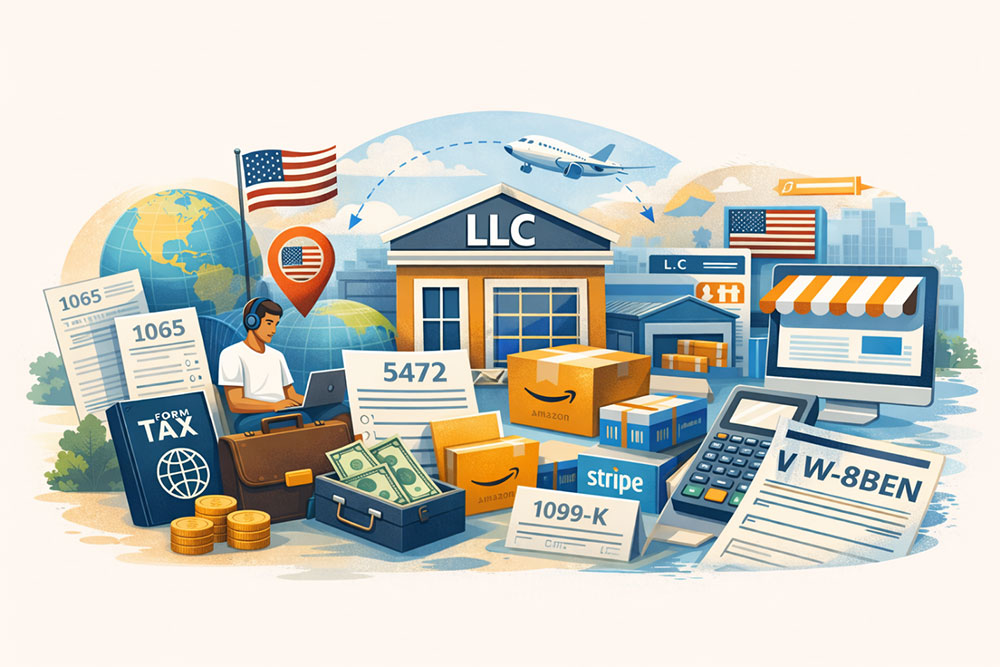
Educational information only — not legal or tax advice. Cross-border tax results depend heavily on facts (where the work is performed, who performs it, where customers are located, whether there is a U.S. office/agent/inventory, treaty positions, and entity classification).
This FAQ is written for common real-world situations like:
- A Wyoming LLC with two foreign owners providing services outside the U.S. to a U.S. customer.
- A foreign-owned single-member LLC used for Stripe/Shopify payments while the owner lives abroad.
- A nonresident earning royalties (e.g., Amazon KDP) and dealing with withholding.
- A U.S. citizen living abroad deciding between LLC vs S-corp for foreign earned income planning.
1) The core rule: owning a U.S. LLC does not automatically mean you owe U.S. income tax
Q1: “We formed a Wyoming LLC, but we live abroad and work abroad. Do we owe U.S. federal income tax?”
Often no, if you are a nonresident and the income is not effectively connected to a U.S. trade or business (USTB). For services, one of the biggest drivers is where the services are actually performed.
The IRS explains that you are usually engaged in a U.S. trade or business when you perform personal services in the United States (and personal services income is generally effectively connected in that case).
Q2: “What if my customer is a U.S. company — does that alone create U.S. tax?”
Not by itself. A U.S. customer can matter for reporting and for state issues, but for federal income tax, the key questions are usually:
- Where is the work performed?
- Do you have people/agents in the U.S. doing the work or closing deals?
- Do you have a U.S. office/place of business?
2) Multi-Member LLC (Two Foreign Owners): What you file when there’s no U.S. income tax
If your LLC has 2+ members, the default U.S. tax classification is usually a partnership (unless you elected corporate treatment).
Q3: “If we owe no U.S. federal income tax, do we still file something?”
Yes — typically you file Form 1065 (U.S. Return of Partnership Income), plus partner reporting schedules.
- Form 1065 is an information return (it reports activity; it usually doesn’t pay income tax itself).
- The partnership issues a Schedule K-1 to each partner.
- Many partnerships also deal with Schedule K-2 / K-3 (international reporting schedules) depending on facts and exceptions.
IRS guidance emphasizes that partnerships use Form 1065 to report items and provide K-1s to partners.
Q4: “When is Form 1065 due?”
For a calendar-year partnership, it is generally due March 15 (the 15th day of the 3rd month after year-end).
Q5: “Can we extend it?”
Yes — partnerships typically request an extension (commonly via Form 7004).
Q6: “What are K-2 and K-3 — and do we really need them?”
K-2/K-3 are the international reporting schedules that support partner-level foreign tax and international items. Whether you must file them depends on your facts and whether you qualify for exceptions (and whether partners request the information). The IRS has updated and expanded K-2/K-3 guidance over time, so this is a “don’t guess” area.
Practical rule: If you have foreign partners, foreign activity, foreign taxes, or cross-border items, assume K-2/K-3 may be relevant unless you clearly meet an exception.
3) Bookkeeping: the #1 reason foreign-owned LLC filings go sideways
Q7: “What bookkeeping do we need before tax filing?”
At minimum, you want clean year-end reports:
- Profit & Loss (Income Statement)
- Balance Sheet
- General Ledger / Transaction detail
- A clear breakdown of:
- revenue streams
- contractor costs
- software/tools
- refunds/chargebacks
- owner contributions/distributions
- foreign exchange gains/losses (if applicable)
Q8: “Can I rely on a dashboard tool that auto-categorizes transactions with AI?”
Treat auto-categorization as a starting point, not the truth. The IRS expects accounting to reflect the economic reality of transactions. If software is guessing wrong categories, your tax filing inherits those errors.
Best practice: Use real bookkeeping software (QuickBooks, Xero, etc.) or a bookkeeping process that produces consistent financial statements you can defend.
4) “We used Wise / Stripe / a U.S. bank account — does that create U.S. tax?”
Q9: “Someone told me I owe U.S. tax just because I used Stripe or a U.S. bank.”
For federal income tax, using U.S. payment rails by itself is usually not the deciding factor. The IRS focus is typically on the nature of the income and where/ how it’s earned.
For service providers, the IRS rules look to facts and circumstances to source compensation for labor/personal services.
Q10: “What about a Form 1099 or 1099-K — does receiving one mean I owe U.S. tax?”
Not automatically. A 1099 (including 1099-K) is information reporting, not a final legal determination of tax.
However:
- If a form reports U.S.-source FDAP income (like dividends/royalties) with insufficient withholding, you may need to file to reconcile tax.
- If it reports service revenue and you performed the work outside the U.S., it may be foreign-source, but you still must keep records to support that position.
5) Single-Member Foreign-Owned LLC (Disregarded Entity): the “No U.S. tax, but big penalties if you don’t file” scenario
This is the common structure for:
- Stripe Atlas single-member LLCs
- non-U.S. founders using a U.S. LLC for payments
Q11: “If I’m a nonresident and I work outside the U.S., do I file a U.S. income tax return?”
Often, no income tax return is required for the business income if it is not effectively connected.
But many foreign-owned disregarded entities must file:
- Pro-forma Form 1120
- Form 5472 (reporting related-party transactions)
And the penalties are serious. IRS instructions discuss a $25,000 penalty regime for Form 5472 compliance failures.
6) Amazon KDP royalties: why “LLC vs no LLC” often doesn’t fix withholding
Q12: “Why do KDP sellers keep hearing ‘it’s royalties’ and withholding applies?”
Because royalties are typically treated as FDAP-type income for nonresidents, which can trigger withholding (often 30% unless reduced by treaty and proper documentation).
Key point: A single-member LLC is usually pass-through/disregarded, so it often does not change the fundamental withholding analysis by itself. You must analyze:
- the income type (royalty vs business profits),
- treaty eligibility,
- documentation (W-8 forms),
- and whether the income is effectively connected.
(If you want a dedicated KDP/royalty FAQ, that should be its own article because the characterization and treaty mechanics deserve a deeper treatment.)
7) U.S. citizens abroad: LLC vs S-corp (and why wages matter for FEIE)
Q13: “I’m a U.S. citizen living abroad. Can I avoid U.S. tax like nonresidents can?”
No. U.S. citizens are generally taxed on worldwide income.
Q14: “Does the Foreign Earned Income Exclusion (FEIE) apply to S-corp income?”
FEIE generally applies to foreign earned income—typically wages (and certain self-employment scenarios), not passive/ pass-through profit amounts. This is why many expat S-corp strategies focus on paying reasonable wages for services actually performed abroad, and then addressing the remaining pass-through profit separately.
Publication 519 explains the framework for when personal services income is effectively connected and the general role of where services are performed.
(Important: payroll/tax/social security treatment across borders can involve totalization agreements and local-country compliance. That requires tailored analysis.)
8) Quick “Red Flag” checklist: facts that can create U.S. tax even for foreigners abroad
You may have U.S. tax exposure if you have any of these:
- You (or staff/contractors) perform services physically in the U.S.
- A dependent agent in the U.S. has authority to negotiate/close contracts on your behalf
- A U.S. office, coworking lease, or fixed place of business is used to run operations
- You receive U.S.-source passive income (e.g., dividends/royalties) without proper withholding documentation
Get this structured correctly before you file
If you want a clean, defensible filing position (and to avoid expensive “fix it later” problems), book a paid consultation and we’ll map your exact facts to the correct filing package and compliance steps: https://oandgaccounting.com/appointment-booking-form/