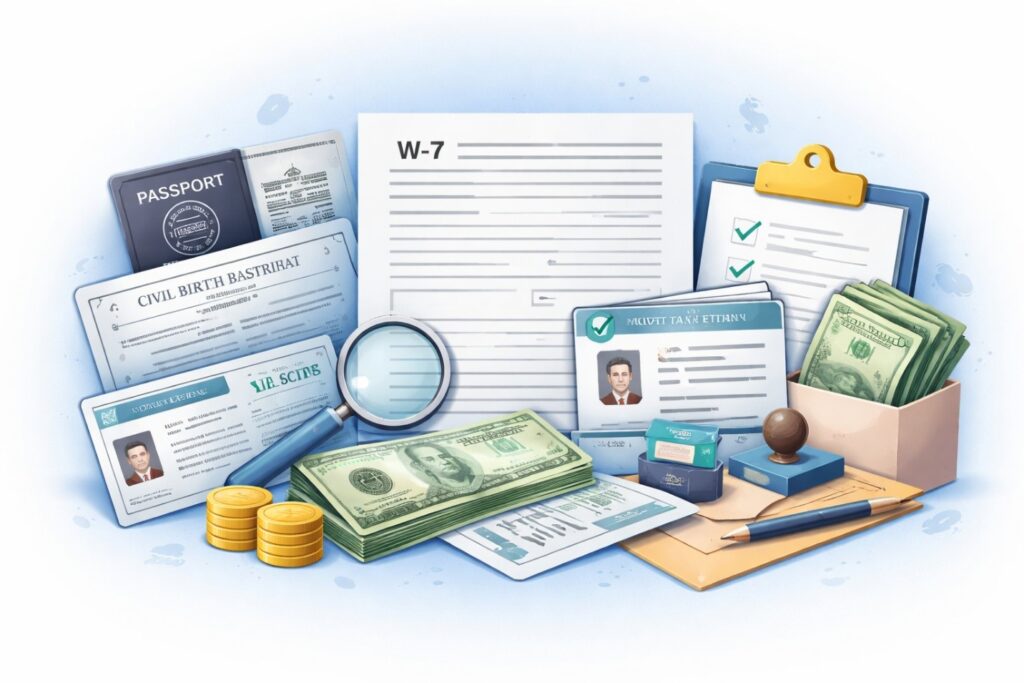
1. What documents are usually required with an ITIN application?
Most ITIN applications require three main components: Form W-7, a federal tax return, and supporting documents that establish identity and foreign status. The supporting documents must match the information shown on Form W-7 and generally must be original documents or certified copies from the issuing agency. Because the process is heavily document-based, this is also one of the most common sources of delay and error.
2. Does every ITIN applicant have to attach a tax return?
No. Many applicants do, but not all. Some qualify under specific exception categories and may submit Form W-7 without an attached return. These exceptions are narrow and technical. They usually apply in situations involving withholding, treaty claims, mortgage-interest reporting, real estate transactions, or certain e-filing obligations.
3. What is the basic proof standard for an ITIN applicant?
The applicant must prove both identity and foreign status. Although that sounds simple, the IRS does not apply a general “reasonable proof” standard. Instead, it requires applicants to use documents from a defined list of acceptable records.
4. Is a passport enough by itself?
Usually, yes. A valid original passport, or a certified copy from the issuing agency, generally satisfies both the identity and foreign-status requirements by itself. That is why the passport is the most important document in many ITIN cases.
5. What if the applicant does not have a valid passport?
In that case, the applicant usually must submit two supporting documents: one proving identity and one proving foreign status. At least one of those documents generally must contain a photograph, unless the applicant falls within a dependent-related exception, such as a child under age 14 or a student under age 18.
6. What kinds of documents can be used if there is no passport?
The acceptable alternatives include documents such as USCIS photo identification, a U.S. visa, a foreign military ID card, a national ID card, a foreign voter registration card, a civil birth certificate, medical records for certain young dependents, school records for certain student dependents, U.S. or foreign driver’s licenses, U.S. military identification, and U.S. state ID cards. The key point is that the IRS uses a closed list, not an open-ended standard.
7. What counts as a certified copy?
A certified copy is not just a notarized copy or a regular photocopy. It must be issued and certified by the original issuing agency, usually with an official seal or stamp. In most cases, the document must also still be current, unless it is the kind of document that does not expire, such as a civil birth certificate.
8. Are there special passport rules?
Yes. If a visa is required for the ITIN application, the relevant U.S. visa pages must also be included. In dependent cases, passport rules are even stricter because a passport may prove identity and foreign status but still fail to prove U.S. residency if it does not show a U.S. date of entry.
9. Do spouses and dependents face different proof rules?
Yes. Their rules are significantly more restrictive. For tax years after 2017, spouses and dependents generally are not eligible for an ITIN or an ITIN renewal unless they are being claimed for an allowable tax benefit or are filing their own return. That means their documentation must support not only identity, but also the specific tax purpose behind the request.
10. What is an “allowable tax benefit” for a spouse or dependent?
An allowable tax benefit may include being a spouse on a joint return or being a dependent connected to head-of-household status, qualifying surviving spouse status, the American Opportunity Tax Credit, the Premium Tax Credit, the Child and Dependent Care Credit, or the Credit for Other Dependents. The return must actually reflect that benefit. Simply listing the person on the return is not enough.
11. What does that mean in practice for supporting documents?
It means the ITIN request must match the actual mechanics of the return. For example, a dependent claimed for head-of-household must appear on a return using HOH status. A dependent tied to qualifying surviving spouse status must appear on a QSS return. A dependent tied to the American Opportunity Tax Credit must appear with Form 8863. A dependent tied to the Premium Tax Credit must appear with Form 8962. A dependent tied to the Child and Dependent Care Credit must appear with Form 2441 listing that person as the qualifying individual. For the Credit for Other Dependents, the dependent must appear on the return and the ODC box must be checked.
12. What is one of the most common spouse or dependent mistakes?
One of the most common mistakes is assuming that listing a person on the return is enough to make them eligible for an ITIN. It is not. The return must show an actual qualifying filing status or qualifying credit relationship.
13. Do dependent applicants also have to prove U.S. residency?
Often, yes. In many cases involving dependents claimed for allowable tax benefits, proving identity and foreign status is not enough. The dependent must also prove U.S. residency unless a narrow exception applies, such as certain military-overseas cases or limited Canada/Mexico situations. Even those exceptions do not always apply if the dependent is being claimed for the Credit for Other Dependents.
14. How does U.S. residency proof work for young children?
For dependents under age 6, acceptable proof of U.S. residency may include a U.S. medical record, a U.S. school record, a U.S. state ID, or a qualifying U.S. visa. For very young children, medical records are often especially important.
15. What about dependents age 6 to under 18?
For that group, acceptable proof may include a U.S. school record, a U.S. state ID, a U.S. driver’s license, or a qualifying U.S. visa. School records tend to be especially important in this age range.
16. What about dependents age 18 or older?
For older dependents, the list is broader. Acceptable proof may include a U.S. school record for someone under age 24, a U.S. state ID, a U.S. driver’s license, a qualifying U.S. visa, a U.S. bank statement, a U.S. rental statement, or a U.S. utility bill showing the applicant’s name and U.S. address.
17. Can a passport prove U.S. residency for a dependent?
Sometimes, but not always. A passport that shows a U.S. date of entry may help prove U.S. residency. But a passport without a U.S. entry date usually cannot serve as a stand-alone residency document for many dependent applications.
18. Is a birth certificate required for children?
Yes, in some cases. If a child under age 18 does not have a valid passport, the IRS requires an original civil birth certificate. This is not just optional backup documentation. It is a required part of the application package in that situation.
19. Do medical and school records have content requirements?
Yes. The IRS does not accept them automatically just because they exist. Medical records for dependents under age 6 should show the child’s name, birthdate, address, the doctor or facility information, and a date of care within 12 months of the application. School records for dependents under age 24 should show the student’s name and address, the school’s name and address, attendance or coursework with grades, and school term dates ending within 12 months of the application.
20. Can printed electronic records count as originals?
Yes, in some categories. Printed electronic copies of medical, school, bank, rental, and utility records may be accepted as originals for ITIN purposes. This is one of the few areas where the documentation rules are more flexible than many applicants expect.
21. What are the main exception categories for applicants filing without an attached return?
There are five main categories. The first covers certain passive income and treaty-benefit cases, such as partnership income, interest, annuities, rental income, and pensions. The second covers other income situations, including certain wages, honoraria, scholarships, fellowships, grants, and gambling income. The third covers certain third-party mortgage-interest reporting situations. The fourth covers certain U.S. real property disposition cases involving the Form 8288 series. The fifth covers certain representatives who need an ITIN for e-filing obligations under Treasury Decision 9363.
22. What kind of proof is required in those exception cases?
The applicant must prove not only identity, but also the underlying tax-reporting event. For example, a mortgage-interest reporting case may require proof of the U.S. mortgage loan, such as a contract of sale. Passive-income or treaty cases may require documents such as Form 1042-S. Real estate disposition cases may require Forms 8288, 8288-A, or 8288-B.
23. Do students, professors, and researchers have special documentation rules?
Yes. These applicants often face an SSN-versus-ITIN issue. In many cases, if the Social Security Administration determines they are not eligible for an SSN, they must attach an SSA denial letter. However, there are exceptions. Certain students, professors, and researchers may use institutional documentation instead, and SEVP-approved institutions may certify original ID documents in some scholarship and fellowship cases.
24. Why are academic ITIN cases often more complicated than expected?
Because they often require a combination of documents rather than just one or two. These cases may involve identity proof, visa-related records, institutional letters, treaty documentation, and evidence of the income stream that creates the ITIN need. They are rarely simple W-7 filings.
25. Where do CAAs fit into the documentation system?
CAAs are important because they can authenticate documents for many applicants, reducing the need to send original identity documents directly to the IRS. More broadly, AAs can help prepare and submit applications but cannot validate documents. CAAs, by contrast, can authenticate most identification documents for primary and secondary taxpayers, except foreign military IDs. For dependents, however, their authority is narrower and is generally limited to passports and birth certificates.
26. Does using a CAA eliminate the need to send documents to the IRS?
Often, but not always. For many primary and secondary taxpayers, using a CAA can reduce or eliminate the need to mail original documents. But in dependent cases, if the supporting document falls outside the limited passport-and-birth-certificate rule, the original or an agency-certified copy may still need to be sent to the IRS.
27. Why is documentation such a major pressure point in the ITIN system?
Because the process is still highly manual. The ITIN unit continues to rely on paper routing and manual review of W-7 applications and supporting documents, and modernization has been delayed. As a result, documentation problems do not just create technical defects. They also increase the chances of delays, lost documents, and inconsistent outcomes.