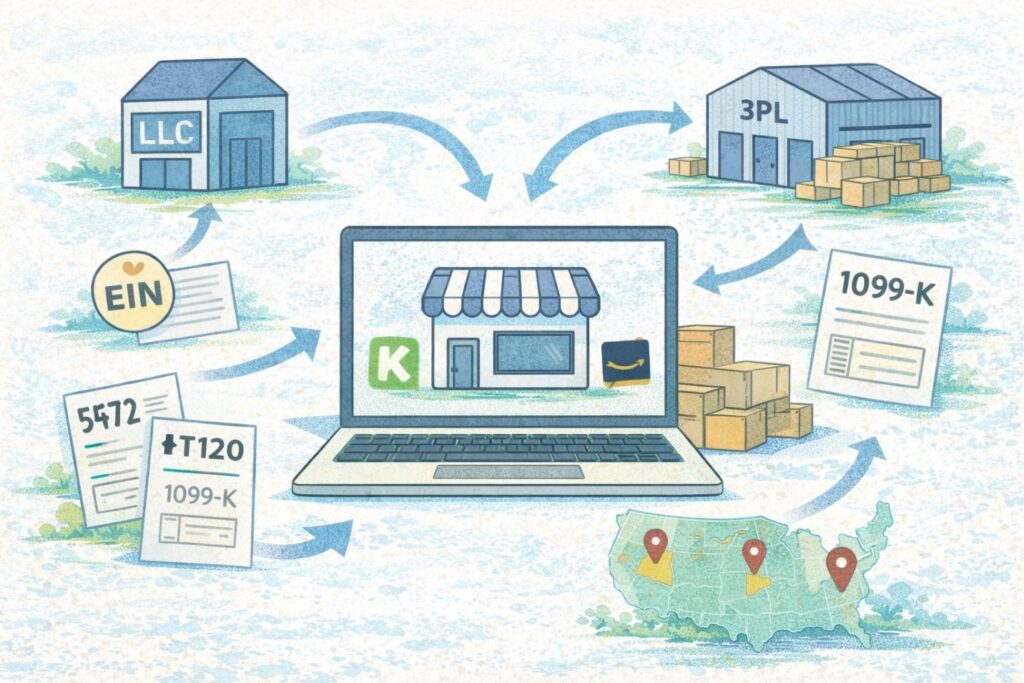
This FAQ is written for non-U.S. founders (EU/UK/AU/etc.) launching a product brand that will sell to U.S. customers through Kickstarter, Amazon, and a webstore, often using a U.S. 3PL warehouse (Ohio, Nevada, etc.).
Educational content only. U.S. tax outcomes are fact-driven and can change with laws, platforms, and where inventory/people are located.
Quick mental model (the part most founders miss)
- Forming a U.S. LLC does not automatically create U.S. income tax.
- But inventory + fulfillment in the U.S. can create state sales tax obligations quickly (sometimes immediately), and may create broader tax complexity depending on the structure and facts.
- Many foreign founders choose a U.S. LLC because it’s often easier operationally (payments, vendors, platform friction), not because it eliminates tax.
Definitions in plain English
“EIN”
An Employer Identification Number is a U.S. tax ID used by the IRS to track an entity. You may need it to open accounts, file forms, and onboard vendors.
“USTB / ECI”
If a foreign person is engaged in a U.S. trade or business, certain income may become Effectively Connected Income (ECI) and taxable in the U.S.
“Sales tax nexus”
Sales tax is state-based. After Wayfair, states can require out-of-state sellers to collect sales tax based on economic activity (sales/transactions) even without a physical storefront.
“Marketplace facilitator”
Platforms like Amazon are often required by state law to collect/remit sales tax for marketplace sales, but that doesn’t automatically cover your Shopify/webstore sales.
FAQ 1) Should I operate using my EU company with an EIN, or form a U.S. LLC?
When using the EU company (with an EIN) can be enough
You might stay with the EU entity if:
- You can successfully run payments (Stripe/Shopify/processing), vendors, and U.S. logistics without constant compliance friction.
- You are comfortable with U.S. tax filings that may still arise from U.S. activity (sales tax, certain information returns, etc.).
- You want to avoid a second legal entity.
When a U.S. LLC is usually the practical choice
A U.S. LLC is often chosen because it can:
- Reduce friction with U.S. vendors, 3PLs, insurance, certain processors, and customer-facing credibility.
- Simplify how a U.S. operating “arm” contracts with U.S. logistics and platforms.
Important: A U.S. LLC is not a magic shield. It’s a tool. Your true obligations still depend on where inventory sits, how fulfillment works, where people work, and what you sell.
FAQ 2) Can a foreign company get an EIN without forming a U.S. entity?
Yes. The IRS allows international applicants to request an EIN using Form SS-4, even without a U.S. SSN/ITIN, using the IRS “international applicant” process.
FAQ 3) What is the “best” U.S. state to form the LLC?
There is no universally “best” state. For foreign founders, state choice is usually about:
A) Cost and maintenance
- Delaware: well-known, but an LLC typically pays an annual tax of $300 (Delaware calls it an annual tax/franchise tax for LLCs).
- Wyoming: often lower annual maintenance; Wyoming’s annual report/license tax has a minimum and is generally marketed as low cost.
- New Mexico: often cited because LLCs generally have no annual report requirement
B) Privacy and public records
Some states display more owner/manager info publicly than others. (This matters to some founders and not at all to others.)
C) Reality check: your “formation state” won’t control your sales tax
If your 3PL warehouse is in Ohio, you may need Ohio sales tax compliance regardless of whether you formed the LLC in Wyoming.
Rule of thumb: pick a formation state for simplicity/cost—but most importantly form your LLC where you anticipate to have inventory, staff, contractors, or high sales.
FAQ 4) If my 3PL is in Ohio or Nevada, what does that change?
Sales tax: a 3PL can create “physical presence” nexus
States commonly treat inventory stored in a warehouse (even a third-party warehouse) as a nexus trigger.
Practical takeaway
- A U.S. warehouse location matters—often more than your LLC formation state.
- Decide early whether you will sell primarily:
- On marketplaces (Amazon), versus
- Direct-to-consumer (Shopify/webstore)
because your sales tax workload can differ dramatically.
FAQ 5) Do I owe U.S. federal income tax if I live abroad and run everything from abroad?
Not automatically.
The IRS distinguishes between:
- FDAP (generally passive U.S.-source income taxed differently), and
- ECI (income connected with a U.S. trade or business).
In general, if a foreign person is engaged in a U.S. trade or business, certain U.S.-source income connected to that business can become ECI and taxable in the U.S.
Common trigger: performing personal services physically in the U.S. during the year is often a strong indicator of U.S. trade/business activity.
What founders often misunderstand
- Sales tax nexus ≠ federal income tax nexus. They are different systems.
- Having a U.S. LLC, bank account, Stripe, or a U.S. mailing address does not automatically mean you owe U.S. federal income tax.
- But inventory + fulfillment + U.S. operations can increase complexity and sometimes risk—this is where tailored advice matters.
FAQ 6) Will I owe U.S. sales tax? What are the thresholds?
After South Dakota v. Wayfair (2018), states can impose sales tax collection obligations based on economic nexus.
The “$100,000 / 200 transactions” concept (and why it’s not universal anymore)
Many states used a version of $100,000 of sales and/or 200 transactions, but several states have been removing the “transactions” test and thresholds vary by state.
Example (Ohio): Ohio’s published guidance uses $100,000 in gross receipts or 200 transactions as the substantial nexus test.
What you should do in real life
- Use a state-by-state nexus chart as a starting point.
- Then evaluate physical presence (inventory/3PL) separately, because physical presence can trigger obligations even if you’re below economic thresholds.
FAQ 7) If I sell on Amazon, does Amazon handle sales tax for me?
Often, yes—for marketplace sales.
Most states adopted marketplace facilitator rules, shifting collection/remittance to the platform for marketplace transactions.
Amazon states it collects/remits sales tax for many marketplace transactions as a facilitator.
But here’s the catch
- Marketplace rules generally cover marketplace orders, not your direct website orders.
- Even when a marketplace collects tax, sellers can still have registration, exemption certificate, or income/franchise considerations depending on the state and structure.
FAQ 8) What federal IRS filings are common for a foreign-owned single-member U.S. LLC?
The big one: Form 5472 + a pro forma Form 1120 (information reporting)
If a foreign person wholly owns a U.S. disregarded entity (like a foreign-owned single-member LLC), the entity is treated as a corporation for limited reporting purposes under Section 6038A, which is where Form 5472 comes in.
Form 5472 reports “reportable transactions” between the LLC and its foreign owner/related parties (examples often include capital contributions, owner payments, reimbursements, intercompany charges).
Why founders care: the penalty risk
A late or missing Form 5472 filing can trigger a significant penalty exposure (commonly discussed as $25,000 in practice). The compliance burden is often about disclosure, not profit.
Where to file (special instruction for foreign-owned U.S. disregarded entities)
The IRS provides specific “where to file” instructions, including marking “Foreign Owned U.S. DE” across the top of the Form 1120 when filing for a foreign-owned U.S. disregarded entity.
FAQ 9) How are Kickstarter funds taxed?
Crowdfunding is not automatically “tax-free.”
The IRS explains that crowdfunding distributions may be taxable depending on facts and circumstances, and emphasizes recordkeeping.
Kickstarter also notes that tax treatment depends on whether funds are income vs. gifts and encourages creators to understand classification.</p>
Practical rule for product brands
If backers are essentially pre-ordering products (rewards), many creators treat proceeds as business receipts (often “advance sales”), then match revenue/expense properly under their accounting method—this is where bookkeeping matters.
FAQ 10) Will I receive a Form 1099-K (Kickstarter/Stripe/Amazon/PayPal), and does it mean I owe tax?
A 1099-K is an information form reporting payment volume. It does not, by itself, determine what is taxable.
The IRS explains the general 1099-K reporting framework and notes that platforms may issue at lower thresholds in some cases.
The IRS also issued updated guidance/FAQs reflecting recent law changes affecting the reporting threshold.
Bottom line: keep clean books so you can reconcile platform totals to real revenue, refunds, shipping, fees, and returns.
FAQ 11) Non-tax compliance for personal care brands: FDA/MoCRA
If you’re selling cosmetics/personal care into the U.S., tax is only half the story.
The FDA’s Modernization of Cosmetics Regulation Act (MoCRA) significantly expanded compliance expectations, including facility registration and product listing frameworks (with exemptions and exceptions).
FDA has issued compliance updates and guidance around registration/listing timelines and processes.
If production is in Australia and product is sold into the U.S., you should ensure your supply chain team understands:
- who the “responsible person” is,
- whether the manufacturing/processing facility must register,
- and product listing responsibilities.
A simple launch checklist (what “compliance” usually means in year 1)
Entity + banking + payments
- Choose entity structure (often foreign-owned SMLLC vs. U.S. corporation)
- Form LLC and obtain EIN
- Payment rails (Stripe/processor onboarding), bank account, and clean documentation
Bookkeeping system from day 1
- Separate business vs. personal flows
- Track: revenue by channel (Kickstarter/Amazon/web), fees, refunds, shipping, COGS, inventory movements
Sales tax (do not guess)
- Identify 3PL states and marketplace vs webstore split
- Monitor economic nexus thresholds (state-by-state)
- Implement marketplace facilitator logic correctly
Federal information reporting (common foreign-owned SMLLC item)
- Determine whether Form 5472 + pro forma 1120 applies
- Follow IRS filing instructions for foreign-owned U.S. DE
Common mistakes (and how to avoid them)
- “No profit = no filing.”
Some U.S. filings are disclosure-based, not profit-based (Form 5472 is the classic trap). - Choosing Alaska/Delaware and thinking sales tax disappears.
Sales tax follows where you have nexus and customers—not your formation state. - Ignoring 3PL and inventory footprint.
Inventory in a state can trigger sales tax obligations even if you’re below economic thresholds. - Treating Kickstarter proceeds as “donations.”
Crowdfunding may be taxable depending on facts; keep documentation and classify properly.
When you should get personalized advice (instead of relying on general FAQs)
Get tailored guidance if any of these are true:
- You will store inventory in multiple states (3PL network, Amazon FBA placement, etc.)
- You (or team members) will travel to the U.S. to manage operations, negotiate deals, attend trade shows, or do fulfillment work
- You are deciding between U.S. LLC vs U.S. corporation vs foreign entity and want to avoid future restructuring tax headaches
Ready to get this structured correctly (before you launch)?
If you’re a non-U.S. founder planning a U.S. launch through Kickstarter + Amazon + a webstore, and you want to set up the right entity, avoid Form 5472 problems, and map out sales tax + 3PL nexus the right way from day one, book a paid consultation.
Use this link to schedule: https://oandgaccounting.com/appointment-booking-form/