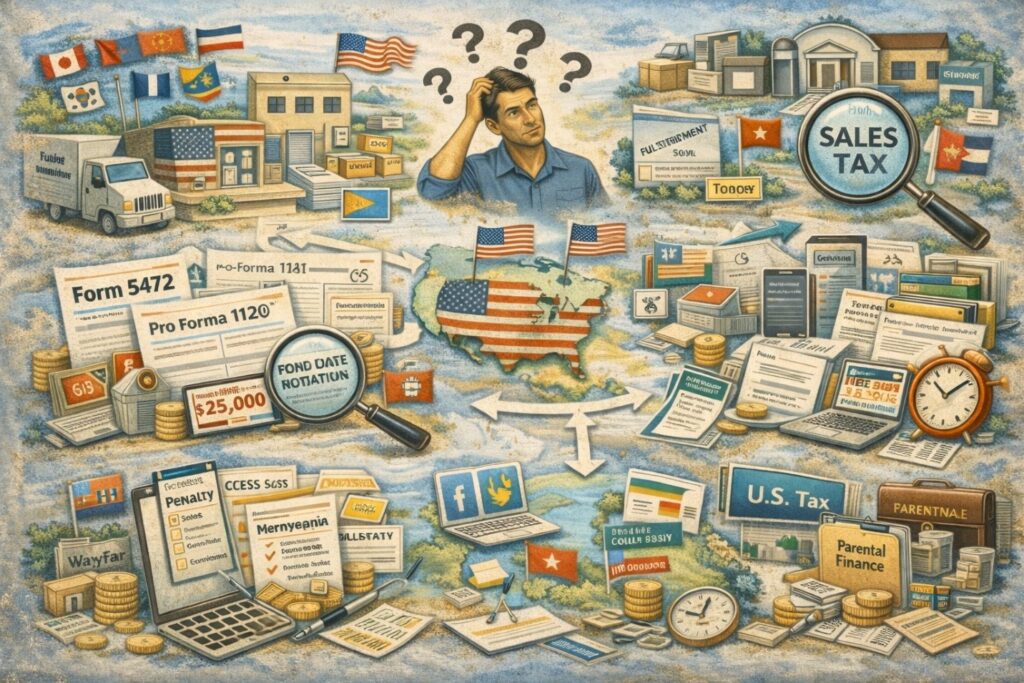
A practical FAQ for non-U.S. founders (ecommerce, subscriptions, Stripe, U.S. manufacturing/fulfillment)
If your U.S. LLC is owned by a foreign individual or foreign company and you sell products to U.S. customers (even via a U.S. manufacturer or fulfillment partner), you may have U.S. filing obligations like Form 5472 + pro-forma Form 1120, plus sales tax registration in multiple states. This FAQ explains what’s required, what triggers U.S. income tax, and how to set up bookkeeping correctly.
Quick definitions
Foreign-owned U.S. LLC (single-member): A U.S. LLC with one owner who is not a U.S. person (either a non-U.S. individual or a foreign corporation). For U.S. income tax, a single-member LLC is disregarded by default (meaning the IRS looks “through” the LLC to the owner, unless an election is made).
Ecommerce/subscription product business: You sell physical goods (like jewelry), often using:
- Stripe (payments)
- a contract manufacturer (produces your goods)
- a 3PL/fulfillment center (stores/ships to customers)
FAQ 1) My U.S. LLC is 100% owned by a foreign company. What do I have to file every year?
In many common foreign-owned single-member LLC setups, the most overlooked “must-file” item is:
✅ Form 5472 + a pro-forma Form 1120 (information filing)
If a foreign person owns a U.S. entity that is treated as a “reporting corporation” for Form 5472 purposes, the IRS generally expects Form 5472 filed with a pro-forma Form 1120 when there are reportable transactions with the foreign owner.
Why this matters
Form 5472 is not “income tax.” It is an information return meant to disclose related-party activity. The IRS can assess significant penalties for failing to file it properly and on time.
FAQ 2) What’s a “reportable transaction” for Form 5472?
For foreign-owned structures, common reportable transactions include:
- Owner capital contributions (money the foreign owner injects into the U.S. LLC)
- Owner withdrawals/distributions (money moving from the LLC to the foreign owner)
- Intercompany charges (management fees, IP/license fees, reimbursements, cost allocations)
- Loans between the foreign owner and the U.S. LLC
Even if your revenue is low—or even zero—these owner-to-LLC cash movements can still create a Form 5472 filing obligation.
FAQ 3) What’s the penalty if we miss Form 5472?
The IRS penalty is large and can compound:
- $25,000 for failure to file (or filing a substantially incomplete return)
- An additional $25,000 for each 30-day period the failure continues after IRS notice
This is why foreign-owned LLC compliance is often “high penalty, low drama”—the filing itself can be simple, but missing it can be expensive.
FAQ 4) Do we owe U.S. income tax if we sell products to U.S. customers?
It depends. You do not determine U.S. income tax purely by where the customer is. You look at whether the foreign owner (through the LLC) is engaged in a U.S. trade or business (USTB) and whether income is effectively connected (ECI).
Practical risk factors that often push toward U.S. income tax exposure
- You have U.S. employees or a dependent agent who can bind the business
- The business has a U.S. office or location
- A U.S. party is doing more than routine services and is effectively operating your U.S. business
Using a true independent contract manufacturer or fulfillment provider can reduce risk, but it does not automatically eliminate U.S. income tax exposure.
FAQ 5) If we don’t owe U.S. income tax, do we still need bookkeeping?
Yes. Good bookkeeping is not optional for foreign-owned U.S. entities.
- Track owner contributions and withdrawals (Form 5472)
- Support U.S. income tax or non-tax positions
- Prepare for future state, payroll, or contractor filings
For product businesses, bookkeeping must separate:
- Revenue (Stripe sales, subscriptions, refunds)
- COGS (manufacturing invoices, landed costs)
- Fulfillment fees
- Merchant fees
- Advertising and affiliate payouts
FAQ 6) Sales tax: do we need to register in every state?
Potentially, yes. Most states apply economic nexus rules and require registration once thresholds are crossed.
The real-world workflow
- Track sales by state
- Register when thresholds are exceeded
- Collect and remit sales tax
- File on the assigned schedule
FAQ 7) If our foreign parent owns the U.S. LLC, can the parent’s finance team access the U.S. books?
Yes. Most accounting platforms allow role-based access for U.S. accountants and overseas finance teams.
FAQ 8) Should we elect the U.S. LLC to be taxed as a corporation?
This is a strategy decision driven by U.S. tax posture and home-country treatment. Elections are typically made via Form 8832.
FAQ 9) What should a foreign-owned product business do in the first 30 days?
Compliance and tax posture
- Confirm ownership and classification
- Map U.S. touchpoints
- Decide on USTB or ECI analysis timing
Books
- Set up accounting software
- Connect bank and Stripe
- Track owner movements cleanly
Sales tax
- Enable state-by-state tracking
- Identify high-risk nexus states
- Choose automation early
Want this set up correctly?
A clean setup now prevents expensive cleanup later. Book a paid consultation here:
https://oandgaccounting.com/appointment-booking-form/