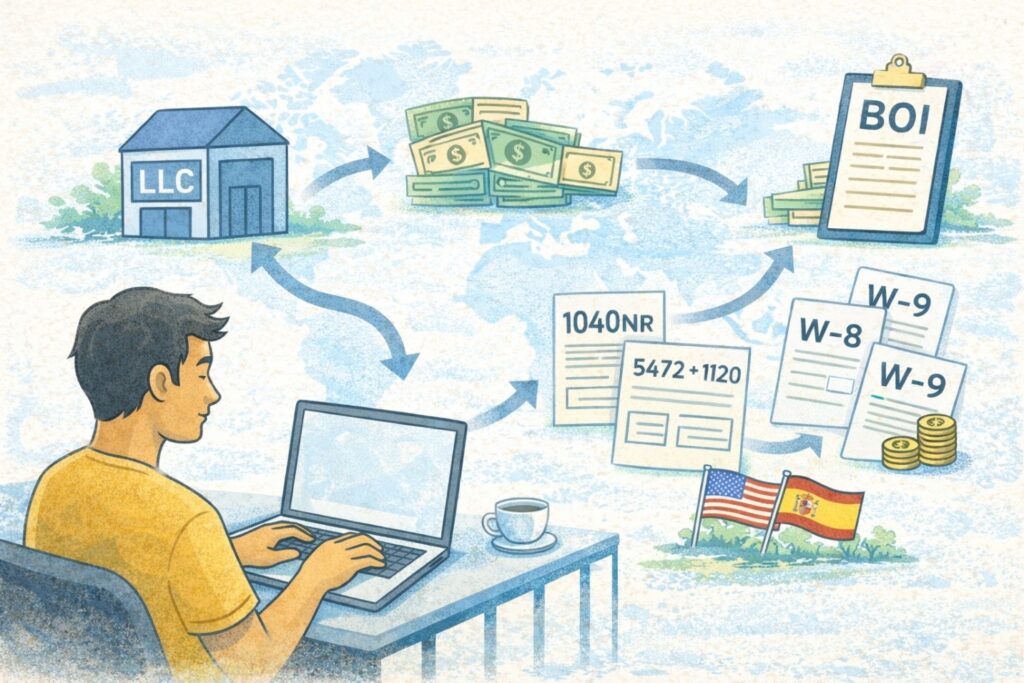
Guidance for non-U.S. founders using a U.S. LLC for payments, ecommerce, consulting, or U.S. customers — written from a CPA/tax attorney perspective.
Important: This is general education, not legal or tax advice for your specific facts.
1) “I’m not a U.S. resident. If I form a U.S. LLC, do I automatically owe U.S. income tax?”
No. Forming a U.S. LLC (or having a U.S. bank account, Stripe, or PayPal) does not automatically create U.S. federal income tax.
What usually controls U.S. income tax exposure is whether your business has a U.S. trade or business and/or effectively connected income (ECI). This is often driven by where the work happens, who is doing the work, and whether you have U.S. people creating revenue on your behalf.
2) What’s the #1 mistake foreign owners make with U.S. LLC compliance?
Assuming “no income” means “no filing.”
For many foreign-owned LLC structures, the IRS filing is about disclosure, not profit. The most common example is Form 5472 with a pro forma Form 1120 for a foreign-owned disregarded entity.
- Owner funding or capital contributions
- Reimbursements paid personally on behalf of the LLC
- Distributions back to the owner
- Formation or dissolution activity
The IRS specifically treats these as reportable transaction categories.
3) Which U.S. tax form do I file? (Most common foreign-owner structures)
A) Foreign-owned single-member U.S. LLC (disregarded entity)
- Form 5472 (related-party transaction reporting)
- Pro forma Form 1120 (used as a filing cover sheet)
This is commonly required even with zero revenue if owner transfers occurred.
B) Foreign-owned multi-member U.S. LLC (partnership)
- Form 1065</li>
- Partner Schedules K-1 (often K-2/K-3 depending on facts)
C) U.S. LLC owned by a foreign corporation
- U.S. LLC: Form 5472 + pro forma 1120 (if disregarded)
- Foreign corporation: potentially Form 1120-F or a protective return strategy
4) I changed ownership — from a foreign individual to a foreign company. Do my U.S. filings change?
Usually, the disclosure framework stays the same. What changes is who the foreign owner is for reporting purposes.
You should also update your operating agreement and membership records.
5) I dissolved my U.S. LLC. Do I still need to file anything?
Often, yes.
State dissolution does not eliminate federal filing obligations. A final Form 5472 with pro forma Form 1120 is commonly required.
Some owners also request EIN closure by letter, which is optional.
6) What is Form 5472 actually reporting?
Form 5472 is a related-party transaction disclosure form.
- Owner capital contributions
- Distributions
- Reimbursements
- Intercompany transfers
- Formation or dissolution activity
7) I received a 1099 or 1099-K. Does that mean I owe U.S. tax?
Not automatically.
A 1099-K reports payment volume, not tax liability. IRS thresholds and guidance have shifted, including updates in late 2025.
- Identify what the payments represent
- Determine U.S. source income or ECI exposure
- Reconcile platform totals to your books
8) W-9 vs W-8: What should foreign owners give U.S. customers?
Disregarded LLCs often confuse payers. Errors here frequently trigger incorrect 1099 reporting.
9) Do I need to form in Delaware or Wyoming?
Focus less on online myths and more on operational reality:
- Where the business is managed
- Where revenue-generating work is performed
- Where assets or inventory are located
Operating elsewhere can still trigger state registration and tax.
10) California warning
If your company is doing business in California, you may owe California LLC taxes even if formed in another state.
California has its own “doing business” thresholds.
11) Does a federal joint return election make my foreign spouse a California resident?
Usually no.
Federal elections affect federal tax treatment only. California residency depends on domicile and physical presence.
California has separate filing mechanics such as Form 540NR.
12) Do I need permits to sell ebooks or digital products?
Usually no special permits are required just to sell ebooks.
- Entity structure
- Income reporting method
- State tax nexus
13) Sales tax: Do foreign businesses need to register everywhere?
It depends.
Sales tax is state-specific and based on both physical economic nexus thresholds. Registration is required before collection.
Digital products and software often change the analysis.
14) BOI report: Is this an IRS filing?
No. BOI reporting is handled by FinCEN, not the IRS.
Rules have changed. Domestic entities are generally exempt, but some foreign entities still have obligations.
Always confirm current rules.
15) What should I do next? (Simple compliance workflow)
- Confirm your entity type and ownership
- Map cash movements
- Assess U.S. trade or business risk
- File required federal forms on time
- Add state analysis only if nexus exists
Ready to get this handled correctly?
If you want a CPA or tax attorney to review your structure and confirm the correct filings, book a paid appointment here:
https://oandgaccounting.com/appointment-booking-form/