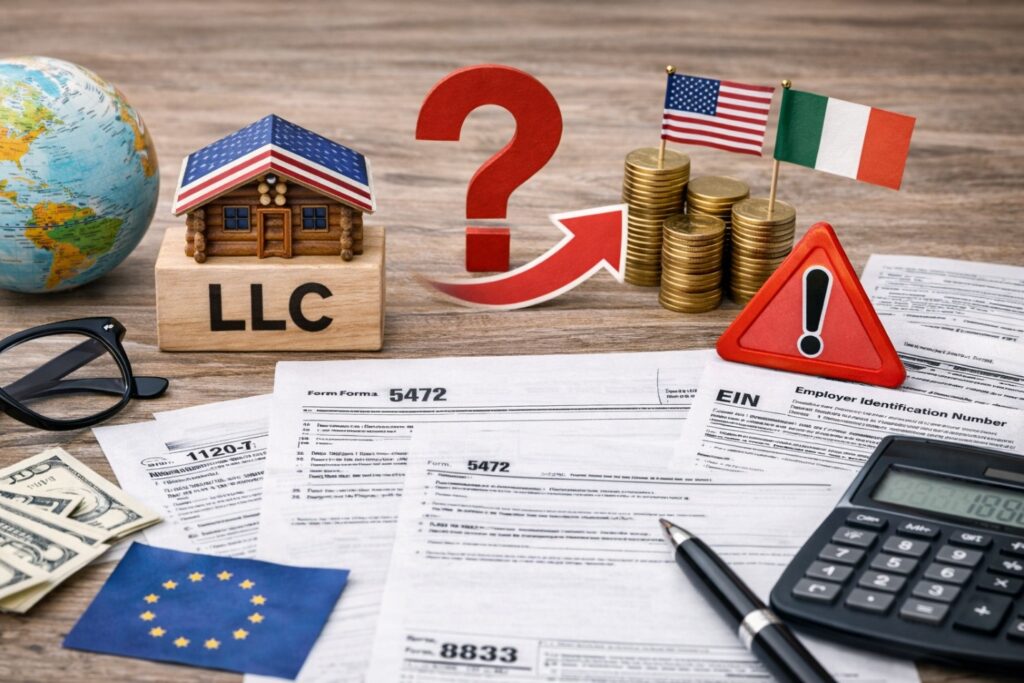
Foreign founders often form a U.S. LLC (Wyoming, Florida, New Mexico, etc.) to invoice clients, open a U.S. bank account, or use payment processors. Then the same questions show up:
- “Do I owe U.S. income tax if I live abroad?”
- “Do I need an SSN or ITIN?”
- “What is Form 5472 and why do people keep warning me about a $25,000 penalty?”
- “My LLC is ‘inactive’—do I still file?”
- “My foreign company invoices my U.S. LLC—what changes?”
- “What if a foreign company has a U.S. warehouse or leases equipment in the U.S.?”
Key takeaways
- A foreign-owned U.S. single-member LLC can be “U.S. income-tax free” in many service-based cases—especially when all work is performed outside the United States.
- “No U.S. income tax” does NOT mean “no U.S. filing.” Many foreign-owned single-member LLCs must file Form 5472 + a pro-forma Form 1120 as an information return.
- Form 5472 penalties are serious—generally $25,000 per year for late/incomplete filing, with potential additional penalties if noncompliance continues after notice.
- You usually do NOT need a U.S. Social Security Number to keep the LLC compliant—many foreign owners file the entity’s information return using the LLC’s EIN.
- State compliance is separate. Example: Florida LLCs must file an annual report between Jan 1 and May 1 each year (late fees apply).
Who this applies to
This FAQ is for you if you are a non-U.S. person who:
- owns 100% of a U.S. single-member LLC (Wyoming/Florida/New Mexico/etc.), and/or
- has a foreign company that invoices (or is paid by) the U.S. LLC, and/or
- is considering using a U.S. LLC as a holding company for a foreign operating company, and/or
- has cross-border operations that may create U.S. tax exposure (warehouse, equipment leasing, U.S. personnel, etc.).
Step 1: Do you owe U.S. federal income tax?
FAQ: “If I live abroad and provide services abroad, is my U.S. LLC taxable in the U.S.?”
Often no, as long as the facts truly support that:
- the services are performed outside the United States,
- you have no U.S. office, no U.S. employees/contractors creating U.S. business presence,
- you are not regularly performing the work while physically in the U.S., and
- you are not running a U.S.-based operation that rises to a U.S. trade or business.
Important: U.S. tax outcomes are fact-driven. The moment your facts change (U.S. personnel, U.S. office, U.S. dependent agent, etc.), the answer can change.
FAQ: “Can I visit the U.S.?”
From a tax perspective, short visits don’t automatically create U.S. tax. But if you’re doing the income-producing work while physically in the U.S., you may create U.S. tax exposure. (Separately: immigration/work authorization rules are their own issue.)
Step 2: “No U.S. tax” does not mean “no U.S. filing”
FAQ: “What do foreign-owned single-member LLCs usually have to file?”
Many foreign-owned U.S. disregarded entities must file:
- Form 5472 (reporting related-party transactions), attached to
- a pro-forma Form 1120 (a “shell” corporate return used only to transmit Form 5472).
The IRS instructions specifically treat a foreign-owned U.S. disregarded entity as a corporation for limited reporting purposes and require it to file Form 5472 attached to a pro-forma Form 1120.
FAQ: “Is this a tax return?”
This filing is primarily an information return, not a “pay U.S. income tax” return.
Step 3: What is a “related party,” and what must be reported?
FAQ: “What counts as a related party transaction for Form 5472?”
Form 5472 focuses on reportable transactions between the U.S. entity and its foreign related parties.
A practical way to think about it:
- You (the foreign owner) are typically a related party.
- Any foreign company you control (commonly 50%+ ownership) can be a related party.
- Payments from the U.S. LLC to your foreign company (or vice-versa) are typically reportable.
- Money you put into the U.S. LLC (capital contributions) and money you take out (distributions) are typically reportable.
The IRS instructions describe the foreign-owned disregarded entity reporting framework and the related-party reporting requirement under Form 5472.
FAQ: “My foreign company invoices my U.S. LLC—what changes?”
If your foreign company is related to you (for example, you own/ control it), then payments such as:
- service fees,
- consulting charges,
- reimbursements,
- management fees,
are commonly reportable transactions for Form 5472 purposes.
Reality check: A “contract” is not always the deciding factor. The IRS cares that the transaction happened and that it’s between related parties. Clean invoices and consistent bookkeeping help.
FAQ: “I paid my registered agent / virtual office from the LLC—does that go on Form 5472?”
Usually no, if the vendor is not related to you. Form 5472 is about related-party transactions. Regular third-party expenses are typically not the focus of Form 5472 reporting.
FAQ: “What is HUF and does it matter?”
Some countries have structures that function like a family unit or family business vehicle (for example, HUF in India). From a U.S. perspective, the question becomes: Is this entity related to you under ownership/control or family relationship rules, and is it transacting with the U.S. LLC? If yes, it may need to be treated as a related party and properly disclosed.
Step 4: Do you need an SSN or ITIN?
FAQ: “I don’t have a U.S. SSN. Can my foreign-owned LLC still be compliant?”
In many common scenarios, yes. Foreign owners frequently file the LLC’s information return using the LLC’s EIN (Employer Identification Number).
You may need a personal U.S. taxpayer ID (like an ITIN) only in certain situations—such as if you personally must file a U.S. return or claim a refund/treaty position that requires identification. (This is fact-specific.)
Step 5: When and how do you file Form 5472 + pro-forma 1120?
FAQ: “When is Form 5472 due?”
Form 5472 is filed with the pro-forma Form 1120 by the due date of Form 1120, including extensions.
FAQ: “Can I e-file?”
Typically no for this foreign-owned disregarded entity package. The IRS instructions state that foreign-owned U.S. disregarded entities cannot e-file Form 1120 and provide a dedicated mailing address/fax procedure.
FAQ: “Where do I send it?”
The IRS provides a dedicated mailing address and fax option for “Foreign-owned U.S. DE” filings in the Form 5472 instructions.
Best practice: keep proof of timely filing (fax confirmation or certified mail tracking).
Step 6: What if you’re late or you never filed?
FAQ: “My LLC was formed years ago and I never filed anything—what now?”
In general, you should assume:
- each tax year can require its own filing, and
- penalties can be assessed per year.
The Form 5472 penalty is generally $25,000 per year for failure to file timely/accurately, with possible additional penalties after notice.
A common “catch-up” approach looks like this:
- Get the EIN (if missing).
- Reconstruct basic activity (formation costs, registered agent fees, owner contributions/distributions, payments to/from foreign related parties).
- Prepare and file a separate Form 5472 + pro-forma 1120 for each year needed.
- If penalties are assessed, evaluate reasonable cause arguments (fact-specific).
Step 7: State compliance checklist (example: Florida)
FAQ: “What do I have to do every year to keep my Florida LLC active?”
Florida requires an annual report filing each year. The Florida Division of Corporations states the annual report must be filed between January 1 and May 1 to avoid late fees.
Separate from taxes, you also must maintain:
- a valid registered agent, and
- accurate company contact information.
Other states (Wyoming, New Mexico, Delaware, etc.) have their own annual report/renewal rules.
Step 8: Using a U.S. LLC as a holding company for a foreign business
FAQ: “If my U.S. LLC owns a foreign company, are foreign dividends taxable in the U.S.?”
Often, for a non-U.S. owner with no U.S. trade/business and no U.S.-source income, U.S. income tax may be $0 on foreign dividends.
But the compliance conversation usually becomes:
“U.S. tax might be $0, but reporting is not $0.”
Dividends and distributions flowing between your foreign company, your U.S. disregarded entity, and you can become reportable transactions that need to be tracked and properly disclosed (depending on the structure and facts).
Step 9: When foreign companies run into U.S. tax exposure (warehouse, rentals, leasing)
FAQ: “If a foreign company has a U.S. warehouse, does it automatically owe U.S. income tax?”
Not automatically. Warehousing can be “low risk” in some treaty/PE frameworks, but you must analyze the full fact pattern, including:
- who signs contracts,
- what activity occurs in the U.S.,
- how income is classified (sales vs services vs rentals/royalties),
- whether income is business profits vs fixed/periodic income (FDAP).
FAQ: “Why does income classification matter so much?”
Because many treaties follow a hierarchy rule: when income is covered by a specific treaty article (e.g., dividends, interest, royalties), that article can control over general “business profits” rules.
FAQ: “Equipment leasing in the U.S.—can that be taxed even without a permanent establishment?”
In some treaties, equipment rental/leasing can be treated as royalties (a category often taxed on a gross basis via withholding), rather than as business profits that require a permanent establishment.
Quick FAQ Index (fast answers)
Do I owe U.S. income tax if I live abroad and do all work abroad?
Often no (fact-dependent). But you may still have an annual Form 5472/pro-forma 1120 filing.
Is Form 5472 optional?
If you’re a foreign-owned U.S. disregarded entity with reportable transactions, it’s commonly required, and penalties can apply.
Do I need an SSN?
Usually no for the entity’s information return package; an EIN is typically the key identifier.
I moved money from the U.S. LLC to my foreign company—what happens?
It’s commonly a related-party reportable transaction that should be properly disclosed.
My LLC is “inactive” and has no bank account—do I still file?
“Inactive” doesn’t automatically eliminate reporting; formation costs, renewals, and owner funding can still create reportable transactions.
I’m behind multiple years—do I file once or for each year?
Commonly each year is its own compliance package; penalties can be assessed per year.
If you want a professional determination (and a clean compliance plan) for your specific situation—including Form 5472 + pro-forma 1120 preparation, catch-up filings, and risk review—book a paid consultation here: https://oandgaccounting.com/appointment-booking-form/