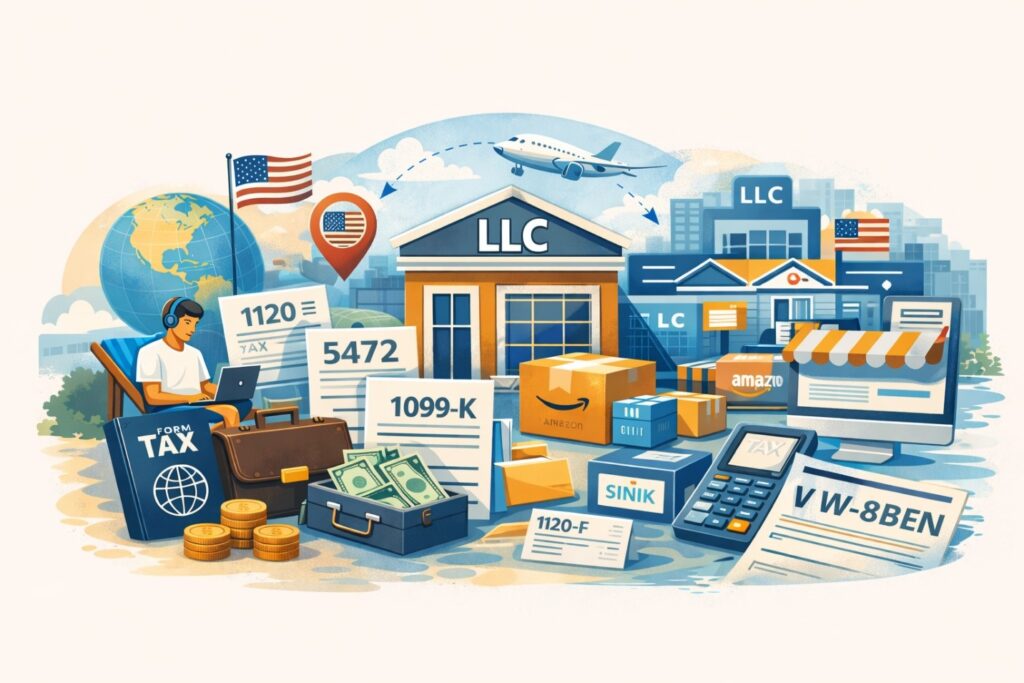
Educational information only (not legal or tax advice). Rules can change based on facts like U.S. travel days, U.S. employees or agents, inventory or warehouses, where services are performed, and how your entity is classified.
This FAQ is written for non-U.S. founders, digital nomads, consultants, SaaS creators,
and foreign companies using a U.S. LLC (Wyoming, Delaware, Colorado, etc.) while operations
happen outside the United States.
1) I’m a foreign owner. Does “having a U.S. LLC” automatically mean I owe U.S. income tax?
Usually no.
A U.S. LLC is just a legal entity wrapper. For U.S. federal income tax, what matters is whether
the owner (or the business through people or agents) is engaged in a U.S. trade or business
and earns effectively connected income (ECI).
It does not depend on using Stripe, having a U.S. bank account, or forming the LLC in Wyoming.
Even when no U.S. income tax is owed, mandatory information returns may still apply,
and penalties for missing them can be significant.
2) What’s the most common “no U.S. income tax, but still must file” scenario?
A) Foreign-owned single-member U.S. LLC (disregarded entity)
If you are a non-U.S. person and:
- You perform the work outside the United States
- You have no U.S. office, employees, or dependent agents
- The activity does not rise to a U.S. trade or business
You may owe zero U.S. federal income tax, but you must still file
Form 5472 with a pro forma Form 1120 when required.
B) Foreign-owned multi-member U.S. LLC (partnership)
A multi-member LLC is commonly treated as a partnership for U.S. tax purposes.
This generally requires filing Form 1065 and issuing partner schedules
(K-1 and often K-2 or K-3), even if no U.S. income tax is due.
3) What exactly is Form 5472 for a foreign-owned LLC?
Form 5472 is an information return used to report reportable transactions
between a U.S. entity and its foreign related parties.
Examples include:
- Owner funding
- Reimbursements
- Intercompany charges
- Capital contributions
- Distributions
Related party in plain English
Typically the foreign owner or foreign parent, and commonly controlled entities.
Ownership of 25 percent or more is the key threshold concept.
Why people fear Form 5472
Because the penalty for failing to file, or filing incorrectly or late,
is severe and commonly cited as twenty five thousand dollars.
4) Is Form 5472 filed per transaction or once per year?
It is typically filed once per year, reporting the years qualifying related-party activity.
It is usually attached to a pro forma Form 1120, which acts as a cover and signature page.
5) If my LLC owner changes from a foreign individual to a foreign company, what changes?
The big picture
If the business activity stays the same, U.S. income tax exposure often does not change
just because the owner changed.
What does change in practice
- Form 5472 reporting still applies because the LLC remains foreign-owned
- The protective filing on the owner side may change
Foreign individual owners often look at Form 1040-NR when appropriate.
Foreign corporate owners often evaluate Form 1120-F as a protective filing.
Corporate housekeeping you should do
- Update operating agreements and ownership records
- Update responsible party and internal compliance documentation
Ownership documentation is not optional, especially if valuation or payments are questioned later.
6) Which form do I give my U.S. customer or client: W-9 or W-8?
If you are not a U.S. person, you generally do not provide a W-9.
Foreign entities typically provide Form W-8BEN-E to document status.
Many payment teams focus on having the correct form on file.
Providing the correct W-8 early avoids year-end reporting problems.
7) If my U.S. client issues me a 1099 anyway, does that mean I owe U.S. tax?
No. A 1099 is an information return and can be issued incorrectly.
Tax liability still depends on where the work is performed
and whether there is a U.S. trade or business.
8) Stripe is sending me Form 1099-K. Does that create U.S. tax?
No. Form 1099-K reports payment processing activity.
It does not by itself create U.S. income tax.
There is no minimum threshold for payment card transactions.
Even small amounts can trigger a form.
You should reconcile the 1099-K with your books, gross receipts,
and your U.S. tax position.
9) Do foreign-owned LLCs owe sales tax?
Sales tax is a state-level issue, not federal.
Many states tax retail sales of tangible personal property,
not professional services.
Custom data analysis and reporting are often treated as services.
Software, licenses, downloads, and SaaS can be treated very differently
depending on the state.
Moving from services to software access often requires a state-by-state review.
10) Do I need to report ownership changes to Delaware or my LLC state?
Delaware generally does not require public filing of ownership changes
for standard LLCs, but internal records must be kept current.
Delaware LLCs also have an annual tax, commonly three hundred dollars,
due June first each year.
11) What are the must-hit compliance items for most foreign-owned U.S. LLCs?
Every year
- Maintain clean books and records
- File required federal information returns
- Renew state registration and registered agent
- Track related-party transactions
If a foreign corporation owns the LLC
Evaluate whether Form 1120-F is required or advisable
as a protective filing depending on U.S. activity and risk profile.
Want help applying this to your exact facts?
If you want a CPA or tax attorney to map your facts to the correct filings
and identify risk areas such as U.S. agents, warehouses, California sourcing,
1099-K cleanup, or reportable transactions,
book a paid consultation here: