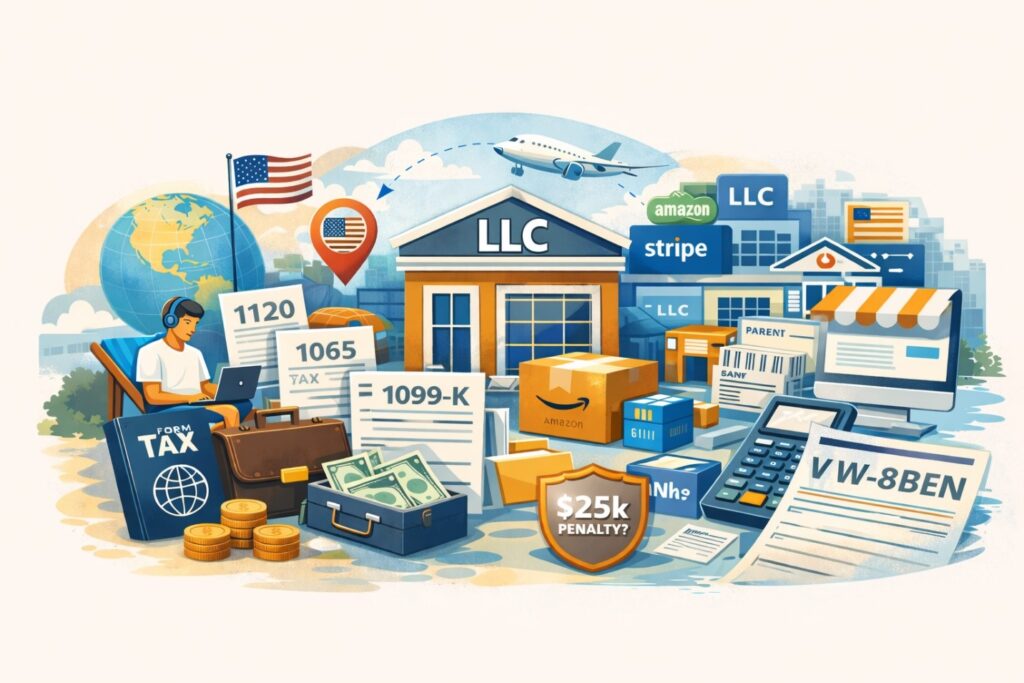
Foreign-Owned U.S. LLC Tax FAQ (Wyoming/Delaware/Colorado): Dropshipping, Consulting, “Stripe-Only” LLCs, and Foreign Parent Companies
Foreign founders often form a U.S. LLC to open a U.S. bank account, use Stripe/Shopify, or look “U.S.-based” to customers. Then the same questions show up:
- Do I owe U.S. federal income tax if I’m not a U.S. resident?
- Does using Stripe, a U.S. LLC, or a U.S. bank account make my income “U.S.-taxable”?
- Why am I hearing about Form 5472, “pro forma” Form 1120, Form 1065, or even Form 1120-F?
- What about a 1099-K from Stripe?
- Do I need U.S. sales tax registration if I sell to U.S. customers?
This FAQ answers those questions in plain English, but with real tax structure behind it.
Educational only. U.S. federal tax results can change quickly based on facts: U.S. employees/contractors, U.S. inventory/warehouses, where services are performed, who signs contracts, and whether you have dependent agents in the U.S.
1) “I’m not a U.S. resident. So I automatically pay zero U.S. tax, right?”
Not automatically.
Being a nonresident is a major factor, but the real driver is whether your income is treated as:
- Effectively Connected Income (ECI) from a U.S. trade or business, or
- Certain types of U.S.-source passive income (commonly handled via withholding).
For many foreign founders who operate entirely outside the U.S. (no U.S. office, no U.S. employees/agents, no U.S. day-to-day operations), U.S. federal income tax can be zero—but filing obligations may still exist.
2) “Does having a U.S. LLC, U.S. bank account, or Stripe/Shopify make my income taxable in the U.S.?”
Usually, no—by itself.
A U.S. LLC and payment processing are often compliance and banking tools, not proof that you have a U.S. trade or business. A payment processor reporting your receipts does not automatically mean those receipts are taxable as U.S. business income.
Where founders get into trouble is when the “U.S.-only for Stripe” LLC quietly grows into:
- U.S. employees or managers,
- U.S. agents with authority to contract,
- a real U.S. office/fixed base.
Those facts can change the tax analysis.
3) Which LLC type do you have? This determines the core IRS forms.
A) Single-Member LLC (foreign-owned)
Most commonly treated as a disregarded entity (unless you elect corporate treatment).
Typical baseline filings (even if no U.S. tax is due):
- Form 5472 + pro forma Form 1120 for a foreign-owned U.S. disregarded entity.
B) Multi-Member LLC (two or more owners)
Default classification is a partnership.
Typical baseline filings:
-
Form 1065 (partnership return) + partner reporting statements (K-1; and often K-2/K-3 depending on facts).
The due date for calendar-year partnerships is generally the 15th day of the 3rd month after year-end (March 15).
C) Foreign company owns the U.S. LLC
If a foreign corporation owns the U.S. LLC, the foreign corporation may have separate considerations
(including whether Form 1120-F is required—often filed as a protective strategy in uncertain cases).
4) What is Form 5472, and do I file it per transaction or once per year?
Form 5472 is annual. You generally file it once per year per reporting entity, covering the year’s reportable related-party transactions.
For foreign founders, the most common reportable transactions are:
- Owner contributions (funding the U.S. LLC),
- Owner distributions (money leaving the U.S. LLC back to the owner/related party),
- Intercompany charges, reimbursements, loans, or settlements with related parties.
The “pro forma Form 1120” part
A foreign-owned U.S. disregarded entity generally files Form 5472 with a pro forma Form 1120.
Due date
Form 5472 is generally due with the related Form 1120 deadline—15th day of the 4th month after year-end
(April 15 for calendar year), and extensions are possible.
5) “I’m late. Is the penalty really $25,000?”
The penalty exposure is real. IRS instructions describe a $25,000 penalty for failing to file Form 5472 when required
(and there can be additional continuation penalties in certain cases).
That said, enforcement and timing vary—don’t treat lack of a penalty notice as proof you’re safe.
The practical best move is usually:
- File the missing forms ASAP (bring yourself current), and
- If a penalty notice arrives later, respond with a reasonable cause explanation based on your facts.
6) “Stripe will issue me a 1099-K. Does that mean I owe U.S. tax?”
A 1099-K is an information report that generally reflects payment volume processed, not your tax conclusion by itself.
It can still create a compliance headache (especially when it conflicts with how you should be classified),
but a 1099-K does not automatically convert foreign-performed services or foreign-run operations into U.S.-taxable income.
Also note: the IRS has been adjusting and clarifying 1099-K thresholds and transition rules in recent years;
don’t rely on old internet summaries.
Practical takeaway: If you receive a 1099-K, you typically need a clean, consistent documentation trail
(entity classification, forms, and a coherent tax position) so you can explain the mismatch if the IRS ever asks.
7) “I sell to U.S. customers. Do I have U.S. sales tax obligations?”
Sales tax is not federal income tax. It’s state-based, and it can apply even when U.S. federal income tax is zero.
The modern rule: “economic nexus”
After the Wayfair-era shift, many states require remote sellers to register and collect sales tax once they exceed a threshold—commonly something like $100,000 in sales, sometimes paired with a transaction count (though many states have been moving away from transaction-count tests).
Do I register in every state?
Only in states where you have nexus (economic nexus or physical nexus).
Physical nexus triggers can include:
- Inventory stored in a state (warehouse/3PL/FBA),
- Employees or certain contractors in a state,
- Offices or other facilities.
“But my U.S. LLC is just a payment processor—does that change sales tax?”
Often, no. Sales tax generally follows the seller’s activity and nexus, not the existence of a U.S. entity “holding the Stripe account.”
Depending on your structure, the “seller of record” might be your foreign company even if the U.S. LLC processes payments.
Action step: Track sales by state and don’t guess. Use a sales tax automation tool and/or a state-by-state review if you’re approaching thresholds.
8) “We provide services, not physical products. Is there sales tax on services?”
In many states, services are not taxed by default, but there are important exceptions:
- Certain “digital goods,”
- Certain SaaS / software access arrangements,
- Certain information services.
If you transition from custom services to licensing software, downloadable products, or SaaS,
you should re-check sales tax rules state-by-state because treatment can change quickly.
9) “Do I need ‘real bookkeeping’ or is my incorporation platform’s ‘AI bookkeeping’ enough?”
If your platform is just auto-categorizing transactions with minimal controls, it may not produce reliable books—especially when you need to defend:
- related-party flows (5472),
- owner distributions/contributions,
- inventory/COGS in ecommerce,
- multi-currency activity,
- contractor payments,
- revenue recognition timing.
For most foreign-owned U.S. LLC structures, “good enough” bookkeeping is bookkeeping that can produce:
- a clean Profit & Loss,
- a clean Balance Sheet,
- and a defensible trail for owner/related-party movements.
10) Annual deadline cheat sheet (most common)
- Form 1065 (multi-member LLC / partnership): generally due March 15 for calendar year; extensions are available.
- Form 5472 + pro forma 1120 (foreign-owned disregarded entity): generally due April 15 for calendar year; extensions are available.
- State compliance: annual report/renewal + registered agent fees (state-specific).
If you want a clean, defensible setup (entity classification, required IRS filings, and a practical plan for 1099-K and sales tax exposure),
book a paid appointment here:
https://oandgaccounting.com/appointment-booking-form/