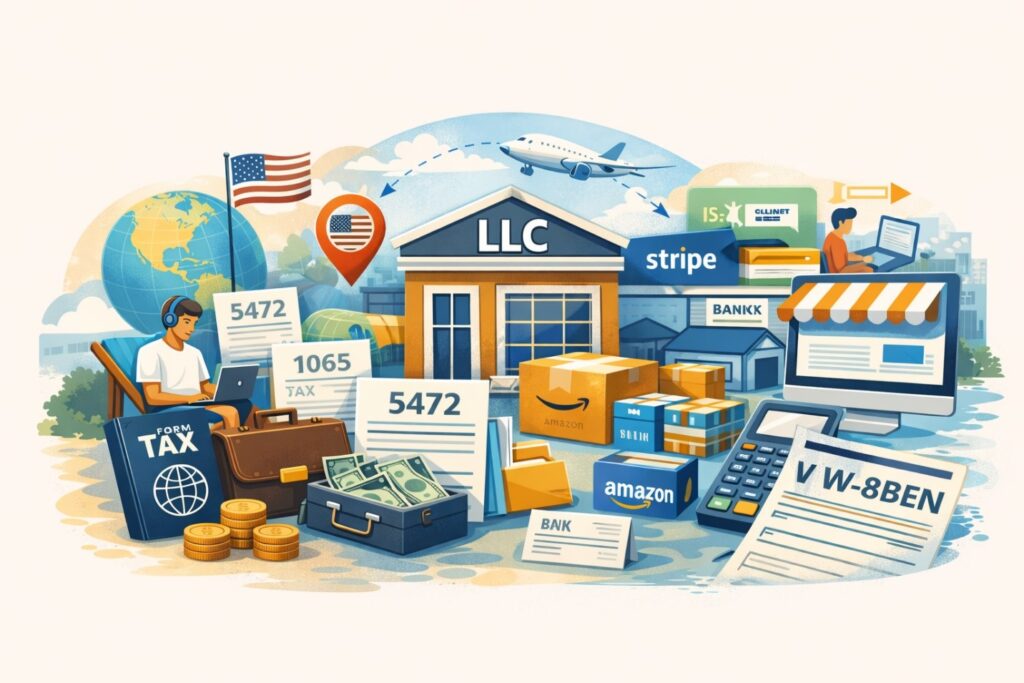
Audience: non-U.S. owners of U.S. LLCs (Wyoming/Delaware/Colorado/etc.) who live and work outside the United States and want to understand (1) when U.S. income tax applies and (2) which IRS forms still must be filed.
Important: This is general educational information, not legal or tax advice. Your results can change based on facts (U.S. travel days, U.S. inventory/warehouses, U.S. staff/agents, and state-level rules).
The “one idea” that makes everything make sense
For non-U.S. persons, the U.S. tax system usually splits into two buckets:
- ECI (Effectively Connected Income)
“Business income connected to a U.S. trade or business.”
If you’re not engaged in a U.S. trade or business, you generally don’t owe U.S. federal income tax on your active business profits. - FDAP (Fixed/Determinable/Annual/Periodical income)
“U.S.-source passive income” like dividends, royalties, certain interest, etc.
This is often taxed via withholding (commonly 30% unless reduced by treaty).
Most confusion happens because people assume:
“I have a U.S. LLC / U.S. bank / Stripe / EIN → therefore I owe U.S. income tax.”
That’s not the rule.
Quick decision tree (use this before anything else)
Step 1: Are you a U.S. person for tax purposes?
- U.S. citizen / green card holder → taxed on worldwide income (different rules).
- Nonresident alien → taxed mainly on ECI + FDAP.
Step 2: Are you doing the work in the U.S. (physically) or through a U.S. presence?
Risk factors that can create U.S. taxable connection include:
- You (or workers you control) are physically in the U.S. performing services
- You have U.S. employees or a dependent agent (someone in the U.S. effectively acting for you)
- You run operations from a U.S. office / fixed base
If no, you’re often in the “no U.S. income tax, but still file compliance forms” category.
Step 3: What type of U.S. LLC do you have?
- Single-member LLC (foreign-owned, disregarded entity) → commonly Form 5472 + pro-forma 1120</li>
- Multi-member LLC (foreign-owned partnership) → commonly Form 1065 + K-1s (and often K-2/K-3)
FAQ 1 — “Do I owe U.S. income tax if I live abroad and do all work abroad?”
Usually, no (federal income tax), as long as:
- the services are performed outside the U.S., and
- you don’t have a U.S. office/agents/employees creating a U.S. business presence.
But: even when the U.S. income tax is $0, the IRS may still require information returns (see FAQs below).
FAQ 2 — “Does using Stripe, Shopify Payments, a U.S. bank account, or a U.S. LLC make my income taxable?”
Not by itself.
Using U.S. payment processors, EINs, or a U.S. LLC is not the test for whether your profits are taxable in the U.S.
What matters far more is:
- where the services are performed, and
- whether you have a U.S. trade or business or U.S.-connected operations.
FAQ 3 — “What do I file if I have a foreign-owned U.S. single-member LLC (disregarded entity)?”
Common baseline filing (even with $0 tax)
- Pro-forma Form 1120 (as a cover page), and
- Form 5472 (to report “reportable transactions” with the foreign owner and other related parties)
Why this matters
Failure to file Form 5472 correctly can trigger very large penalties (commonly cited as $25,000 per year/per failure).
FAQ 4 — “What is a ‘reportable transaction’ for Form 5472?”
Think of “reportable transaction” as money or value moving between the LLC and its foreign owner (or other related parties).
Very common examples:
- Owner funds the LLC (capital contribution)
- LLC pays the owner back (distribution)
- Owner pays LLC expenses personally (often treated as contribution/reimbursement)
- LLC pays owner expenses (often distribution/compensation depending on facts)
- Loans between owner and LLC
- Intercompany payments (management fees, cost sharing, reimbursements)
Practical tip: If there was any owner funding, reimbursements, or money movement between you and the LLC, assume 5472 is in play and document it cleanly.
FAQ 5 — “How often do I file Form 5472—per transaction or once per year?”
Once per year, attached to the pro-forma Form 1120, reporting the year’s reportable transactions.
FAQ 6 — “If I have a parent LLC and a subsidiary LLC, do I file more than one 5472?”
Yes—each U.S. disregarded entity generally files its own annual Form 5472 package if it has reportable transactions. (In practice: parent has its reportable transactions; subsidiary has its own.)
FAQ 7 — “What do I file if my U.S. LLC has two foreign owners (multi-member LLC/partnership)?”
A U.S. multi-member LLC taxed as a partnership typically files:
- Form 1065 (partnership information return)
- Schedule K-1 for each partner
- Often Schedule K-2 / K-3 depending on international items/partner needs (facts vary)
Even if you don’t owe U.S. income tax (because there’s no U.S. trade or business), the information return may still be required.
FAQ 8 — “We’re foreign owners running dropshipping from Romania (or IT services in Latin America). U.S. customers pay us. Do we owe U.S. federal income tax?”
Maybe, but many truly-remote models end up with $0 U.S. federal income tax if:
- management and operations are outside the U.S.,
- you don’t have U.S. employees/agents creating a U.S. trade or business, and
- your fulfillment/warehouse footprint doesn’t rise to U.S. trade or business (this is fact-heavy).
Two big “watch outs” in ecommerce/dropshipping:
- U.S. office/fixed base/employee/warehouse can change the analysis.
- State sales tax nexus can apply even when federal income tax does not.
FAQ 9 — “My U.S. client wants a tax form from me. Do I give them W-9 or W-8?”
If you are a foreign individual
- Usually Form W-8BEN (not W-9)
If the payee is a foreign entity
- Usually Form W-8BEN-E
Important detail: W-8BEN has rules about providing a foreign tax identifying number (FTIN) in many situations. The IRS instructions explain when an FTIN is required and when exceptions may apply.
FAQ 10 — “Will my U.S. client issue me a 1099? What if they do?”
- Companies should not issue a 1099 to a foreign contractor paid for services performed outside the U.S.
- Some accounting departments still issue forms anyway “to keep the process simple.”
Key point: A 1099 is an information form, not the law.
If you are not taxable under the rules, you don’t become taxable just because a form exists. Still—bad reporting can create IRS notices, so it’s best to get the paperwork right upfront (W-8BEN/W-8BEN-E).
FAQ 11 — “Stripe says I’ll get a Form 1099-K. Do I have to ‘submit’ it to the IRS?”
Usually no—the payer/processor issues it to you and files it with the IRS. Your job is to:
- reconcile it to your books, and
- report the income correctly in the right country and on the right return (if any).
Also, receiving a 1099-K does not automatically mean the income is taxable in the U.S. by itself—it’s reporting. IRS guidance explains the 1099-K rules and thresholds.
FAQ 12 — “I still have U.S. investment accounts. What if I receive dividends or royalties?”
Dividends/royalties are often FDAP and commonly subject to withholding (default can be 30% unless reduced by treaty). If withholding wasn’t done correctly, you may need to file a U.S. nonresident return to report and pay the tax (or to claim a refund if too much was withheld).
This is a different topic than your service/business income.
FAQ 13 — “I used to live/work in the U.S. (F-1/OPT/H-1B), left mid-year, and became a contractor abroad. How do I file?”
This is the “departure year” problem. Your filing can involve:
- residency tests (including special rules for students),
- potentially dual-status treatment, and
- careful state residency rules.
This area is highly fact-specific (days in U.S., visa type, treaty positions, where services were performed, and where you established your next tax home).
FAQ 14 — “Does the state matter (California, Virginia, etc.) if I’m outside the U.S.?”
Yes. State rules are separate from federal rules and can be more aggressive or just different:
- State income tax residency depends on each state’s legal tests (domicile, statutory residency, etc.).
- Sourcing rules for services vary (some use market/benefit-based concepts; others use where the work is performed).
- Sales tax nexus can apply based on customer location and thresholds.
If you’re trying to end state residency mid-year, be prepared to prove it.
FAQ 15 — “Where should I form the LLC—Delaware, Wyoming, Wisconsin, etc.?”
For most operating businesses, the practical rule is:
Form where you’re actually operating or have people/assets
Consider:
- Where the business is managed/controlled
- Where employees or key contractors are located
- Where assets (inventory, equipment, warehouse) are located
Delaware is not “mandatory”
Delaware is popular for certain investor/VC structures, but many small/medium businesses don’t need it.
You can form in one state and “foreign qualify” in another
If you form in State A but operate in State B, you may need to register in State B anyway.
Common mistakes foreigners make (and how to avoid them)
- Assuming “no U.S. income tax” means “no U.S. filings.”
Wrong—5472/1120 or 1065/K-1s are common even with $0 tax. - Not tracking owner funding/reimbursements.
These are often the exact “reportable transactions” that trigger 5472. - Ignoring state sales tax nexus.
Federal income tax and state sales tax are totally different systems. - Letting the payment processor drive the tax conclusion.
Stripe/PayPal forms are reporting tools—not the legal analysis.
What to keep in your records (minimum compliance file)
- LLC formation docs + EIN letter
- Monthly bookkeeping reports (P&L + Balance Sheet)
- Bank statements + Stripe/Shopify payout reports
- Owner contribution/distribution log
- Contracts showing where services are performed
- Any W-8 forms provided to payers
- Any 1099-K / 1042-S / 1099 you receive (even if “wrong”)
If you want a CPA/tax attorney to review your exact facts (where the work is performed, whether you have U.S. nexus/agents/inventory, which IRS forms you must file, and how to avoid $25,000 Form 5472 penalty exposure), book a paid consultation here:
https://oandgaccounting.com/appointment-booking-form/