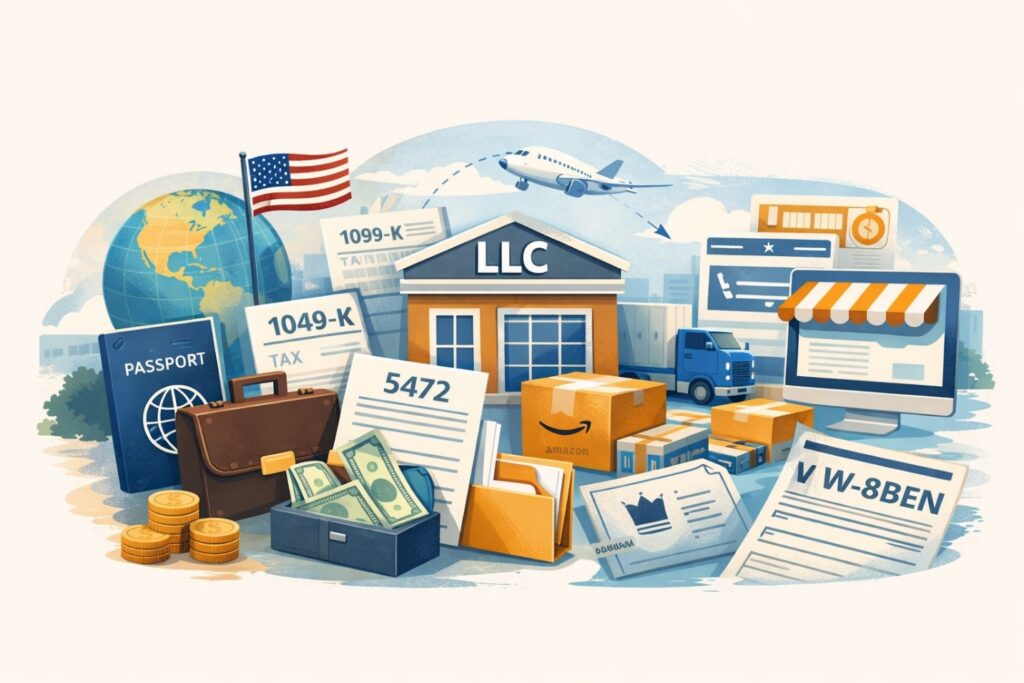
This FAQ is written for non-U.S. founders, digital nomads, creators, consultants, and ecommerce sellers who use a U.S. LLC (Wyoming/Delaware/etc.) while living and working outside the United States.
Important: This is general educational information, not legal or tax advice. Your exact result can change if you have U.S. inventory, U.S. workers/agents, U.S. office space, U.S. travel days, or U.S.-source passive income.
Core concept: The U.S. taxes nonresidents in two very different ways
1) ECI (Effectively Connected Income) — “active business income tied to a U.S. business”
If you are a nonresident alien, the U.S. generally taxes you on ECI (income connected with a U.S. trade or business).
2) FDAP — “U.S.-source passive income”
Nonresidents are also commonly taxed (via withholding) on certain U.S.-source “fixed or determinable annual or periodical” (FDAP) income, like royalties, dividends, interest, etc.
These buckets matter because many foreign founders confuse “I have a U.S. LLC / U.S. Stripe / U.S. bank” with “I owe U.S. income tax.” Those are not the same.
FAQ 1) “I’m a foreign owner, living abroad, providing online services. Do I owe U.S. income tax?”
Usually no, if:
- You perform the services outside the U.S. (the work happens abroad), and
- You do not have a U.S. office, employees, or dependent agents creating a U.S. trade/business for you.
Why: Services income is generally sourced to where the services are performed. U.S.-source services are tied to services performed in the U.S.; services performed outside the U.S. are generally foreign-source.
Key point: Even if your students/clients are in the U.S., the biggest driver (for services) is still where you perform the work, not where the customer is.
FAQ 2) “Does a U.S. LLC, a U.S. bank account, or Stripe make my foreign services taxable in the U.S.?”
Not by itself. A U.S. LLC or Stripe account is not the legal test for U.S. income tax.
What matters is whether you have U.S. business activity that rises to a U.S. trade or business (ECI rules), or whether you have U.S.-source FDAP (royalties/dividends/interest, etc.).
FAQ 3) “I will receive a Form 1099-K from Stripe. Does that mean I owe U.S. tax?”
Not automatically.
What Form 1099-K really is
A 1099-K is an information return reporting gross payment volume processed by a payment platform (like Stripe). It’s not a tax bill.
Why it can still create problems
If the IRS receives a 1099-K showing large gross receipts and you file no U.S. return at all, you could receive a notice asking you to explain the income.
That doesn’t mean you owe tax — it means you may need to respond (and in some cases, file a return) to show why the income is not taxable in the U.S. under the sourcing/ECI rules.
1099-K thresholds change (a lot)
The IRS has issued multiple rounds of transition guidance and, more recently, referenced new legislation affecting the threshold. For example, IRS guidance discussed (i) transition thresholds (including $5,000 for certain periods) and (ii) later changes tied to “One Big Beautiful Bill” that referenced reinstating the older $20,000/200-transaction threshold for third-party settlement organizations.
Bottom line: Your “1099-K = tax due” fear is common, but it’s not how the law works. It’s a reporting form. Your tax depends on source + U.S. trade/business + treaty/withholding facts.
FAQ 4) “Do I need to file a U.S. income tax return (Form 1040-NR) if I live abroad all year?”
Sometimes yes, sometimes no. Common situations:
A) You ONLY have foreign-source service income (services performed abroad)
Often no 1040-NR is required, because there’s no U.S.-taxable ECI/FDAP from those services.
B) You also have U.S.-source FDAP (dividends/interest/royalties)
Then you may need a 1040-NR, especially if:
- withholding was not done, or
- you want to claim a refund or treaty rate.
FDAP withholding rules are a major reason nonresidents end up filing.
FAQ 5) “I’m a foreign person with a U.S. single-member LLC (disregarded entity). What must I file?”
Even when no U.S. income tax is due, many foreign owners still have mandatory IRS reporting.
The common filing package
For a foreign-owned U.S. disregarded entity, the typical requirement is:
- Form 5472 (reporting “reportable transactions” with the foreign owner/related parties), attached to
- a pro forma Form 1120 (a “shell” corporate return used as the filing vehicle).
Due date (typical calendar year)
Generally due the 15th day of the 4th month after year-end (often April 15 for calendar-year filers), with extension rules available.
Penalty risk is real
Failure to file Form 5472 when required can trigger a $25,000 penalty (and additional penalties if the failure continues after IRS notice).
Plain English: Even if your U.S. tax is “$0,” you still may have a high-stakes reporting obligation.
FAQ 6) “What do I put on Form W-8BEN if I don’t have a foreign TIN yet?”
If you are not claiming treaty benefits, you can often complete the W-8BEN using your foreign status information and follow the instructions on when a foreign TIN is required.
The IRS instructions explain when a foreign TIN is required (often tied to claiming treaty benefits) and when it may be omitted in certain circumstances.
Practical approach many payers accept:
- Provide your foreign country of citizenship/residence details,
- Provide a mailing address,
- Provide your U.S. TIN (SSN/ITIN) if you have one,
- Do not claim treaty benefits unless you can legitimately support them.
FAQ 7) “Can my U.S. client issue me a 1099 anyway? Will that make me taxable?”
A U.S. payer may try to issue forms “by default” because their accounting department wants one workflow. A 1099 does not override the law.
If your income is not taxable in the U.S. (for example, foreign-source services performed abroad), you generally rely on the legal rules — not the payer’s paperwork habits.
That said, mismatched reporting can cause IRS notices, so it’s better to get the onboarding right (often W-8BEN for foreign individuals).
FAQ 8) “Why is Amazon KDP treated differently than Amazon FBA or Shopify dropshipping?”
Because not all Amazon revenue is the same “type” of income.
KDP (common issue): royalties
KDP often pays creators under a structure treated as royalty-type income, which can fall into FDAP for nonresidents and trigger withholding (unless reduced by treaty).
FBA / dropshipping (often): active sales income
Selling goods can look more like active business income. For nonresidents, that typically becomes taxable in the U.S. only if it is connected to a U.S. trade or business (e.g., U.S. office, dependent agents, certain inventory/fulfillment fact patterns).
Important nuance: Warehousing, fulfillment, and who “owns” inventory (and where) can change the analysis. If you’re using U.S. warehouses, don’t assume “no U.S. tax” without a careful review.
FAQ 9) “We have a foreign-owned multi-member LLC (partnership). We live abroad. Do we owe U.S. income tax?”
Often no U.S. income tax, if the partnership is not engaged in a U.S. trade or business — but you may still have major information return obligations.
Common filings for a partnership include:
This is where good bookkeeping matters — because even “information returns” can carry serious penalties if done wrong or late.
FAQ 10) “Sales tax: If we sell to U.S. customers, do we owe sales tax even if we owe no federal income tax?”
Possibly yes.
Sales tax is state-level, and many states impose economic nexus thresholds. This is separate from federal income tax. It’s common for foreign ecommerce sellers to owe sales tax compliance even when U.S. federal income tax is $0.
Quick decision tree (high-level)
- You perform services abroad → often no U.S. income tax, but may have 5472/pro forma 1120 if foreign-owned DRE.
- You receive U.S.-source royalties/dividends/interest → likely withholding / 1040-NR issues.
- You run ecommerce with U.S. inventory/warehouses/agents → may trigger U.S. trade or business analysis.
- You receive a 1099-K → reporting form; tax depends on the underlying sourcing/ECI rules.
If you want a professional review (classification, sourcing, ECI/FDAP analysis, proper filings like 5472/pro forma 1120, and a clean plan for Stripe/1099-K risk), book a paid consult here: