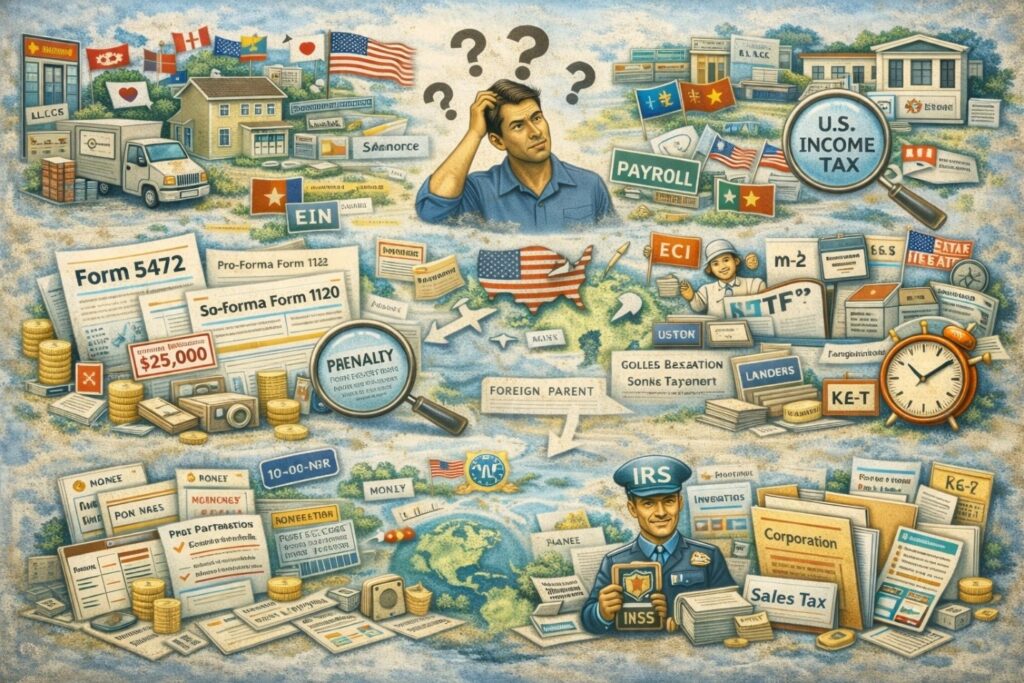
If you’re a non-U.S. founder running a U.S. LLC (ecommerce, SaaS, Amazon-style fulfillment, contract manufacturing, or international online sales), U.S. tax rules can feel backwards:
- You might need U.S. filing forms even when you owe $0 U.S. income tax.
- You might owe U.S. income tax even if you never set foot in the U.S. (especially with U.S. real estate or U.S. employees or operations).
- LLC does not automatically mean corporation for tax purposes.
This FAQ breaks the topic down in simple language and covers the most common setups we see: overseas owners, U.S. customers, U.S. contractors (manufacturers, 3PLs, prep centers), and cross-border founders trying to avoid surprises.
Quick Glossary
Disregarded entity (single-member LLC)
A U.S. LLC with one owner is usually ignored (disregarded) for federal income tax unless it elects corporate treatment. In practice, the IRS treats the LLC’s activity as belonging directly to the owner.
These concepts drive whether business profit is taxed in the U.S. This is a facts-and-circumstances analysis based on people, place, control, and what is happening in the U.S.
Form 5472 + pro-forma Form 1120
Many foreign-owned U.S. LLCs must file these annually even if they owe no U.S. income tax.
1) I’m foreign and I own a U.S. LLC. Do I automatically owe U.S. income tax?
Not automatically.
A foreign owner can have a U.S. LLC and sell to U.S. customers without automatically owing U.S. federal income tax if the income is not ECI and the business is not treated as conducted through U.S. employees, agents, or offices in a way that rises to a U.S. trade or business.
That said, many foreign owners still have U.S. filing obligations, especially Form 5472, even when there is no income tax due.
2) My LLC is owned by a foreign company. Does that change anything?
Yes. Usually it increases reporting.
A U.S. disregarded entity that is 100 percent foreign-owned is treated as a reporting corporation for Form 5472 purposes and must report reportable transactions with its foreign owner or related parties.
- Owner funding or capital contributions
- Owner reimbursements
- Owner distributions or withdrawals
- Related-party payments such as management fees, royalties, or cost sharing
3) If my LLC is a disregarded entity, what do I file each year?
If you are a foreign-owned single-member U.S. LLC, you generally file:
- Form 5472
- Pro-forma Form 1120 used as a filing wrapper
Big warning
Failure to file or filing incorrectly can trigger a $25,000 penalty per year.
Timing
Form 5472 is due with the Form 1120 wrapper, with extensions available.
Even zero-activity years often still require reporting if money moved between you and the LLC.
4) Does using a U.S. manufacturer or fulfillment center mean I am doing business in the U.S.?
Not always.
Many foreign founders use independent U.S. vendors such as contract manufacturers, 3PLs, prep centers, and payment processors.
Using independent vendors alone does not automatically create a U.S. trade or business, especially when you do not control their employees or daily operations.
- Who controls pricing and customer terms
- Who owns and controls inventory
- Whether you have U.S. employees or dependent agents
- Whether there is a fixed U.S. office
- Where key decisions are made
5) What if my U.S. LLC owns U.S. real estate?
This is different.
U.S. real estate commonly creates unavoidable U.S. tax filing obligations and U.S. taxable income, even for owners living abroad.
6) Can I fix the disregarded-entity issue by adding a U.S. friend?
You can, but it creates new complexity.
- Form 1065 partnership return
- K-1 and often K-2 and K-3 filings
- Foreign partner withholding requirements
- More complex compliance
Adding a member purely for tax optics is usually a poor trade unless the relationship is real and commercial.
7) Should I elect my LLC to be taxed as a corporation?
Sometimes yes.
- Separating business and personal tax exposure
- Cleaner documentation for banks and investors
- Long-term continuity planning
- Alignment with U.S. payroll and operations
Corporations also bring higher compliance, formal filings, and possible double taxation.
8) If I move to the U.S. later, will this structure cause problems?
It can.
U.S. tax residency changes worldwide taxation, and immigration processes often expect proof of U.S. operations.
This is about planning early, not manufacturing paperwork.
9) Are owner withdrawals the same as wages?
No.
Disregarded LLC owners typically take distributions, not payroll wages, unless the entity is taxed as a corporation.
10) Sales tax vs income tax
Income tax applies to profit. Sales tax is collected and remitted based on customer location.
Even with zero federal income tax, state sales tax obligations may still apply.
11) What records should I keep?
- LLC formation and EIN documents
- Bank and Stripe statements
- Vendor and fulfillment contracts
- Inventory location reports
- Related-party transaction logs
Need a professional review?
If you want a clear, defensible plan for Form 5472, entity classification, and U.S. tax exposure, book a paid consultation here: