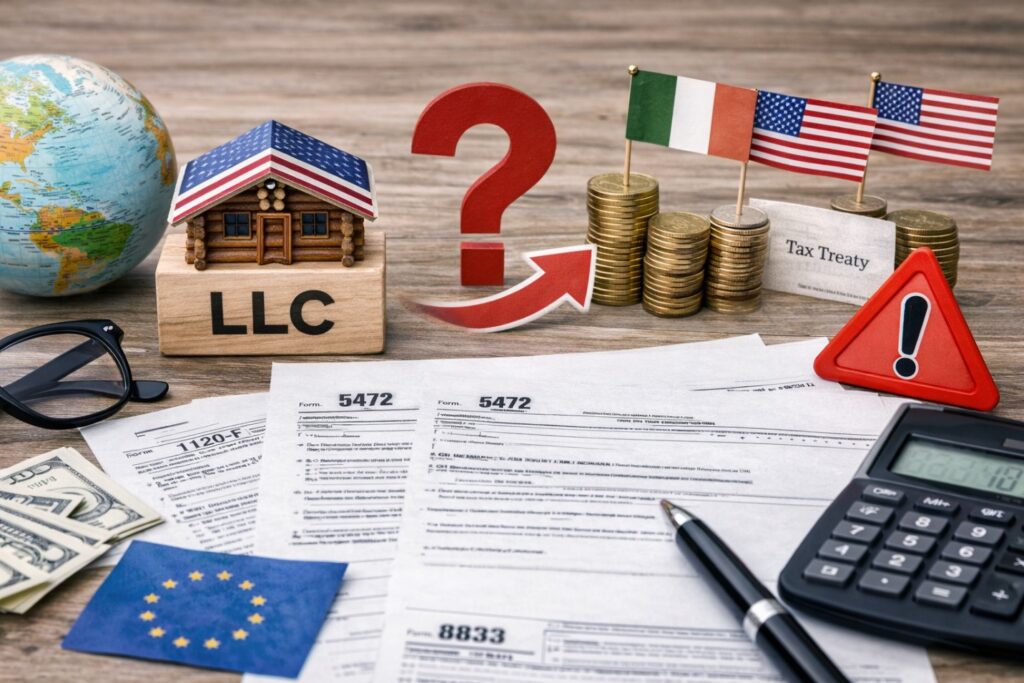
Foreign founders often set up a Wyoming / New Mexico / Delaware LLC or corporation to open a U.S. bank account, work with Stripe, own a foreign subsidiary, or store inventory/equipment in the U.S. Then the same questions come up:
- Do I owe U.S. income tax just because I formed a U.S. entity?
- If my U.S. LLC is “inactive,” do I still have IRS filings?
- If a foreign company leases equipment used in the U.S., is that “business profits” (PE-based) or “royalties” (gross withholding)?
- Do I need Form 1120-F? A protective 1120-F? Form 8833? Form 5472?
Key terms
Foreign person: Not a U.S. citizen and not a U.S. tax resident.
Disregarded entity (DE): A single-member LLC that is ignored for U.S. income tax (the owner is taxed instead).
FDAP: Passive-type U.S. income (think rent/royalties/interest/dividends) often taxed on gross at a flat rate.
ECI: “Effectively Connected Income” — active business-type income connected to a U.S. trade or business, generally taxed on net (after deductions).
Permanent Establishment (PE): A treaty concept that often gates U.S. tax on business profits—but not on income covered by other treaty articles (like royalties).
Protective Form 1120-F: A procedural filing used when a foreign corporation believes it has no U.S. trade or business, but files to preserve the right to claim deductions if the IRS later disagrees.
Quick reality check: the U.S. can impose tax, reporting, or both
A common misunderstanding is: “If I don’t owe U.S. income tax, I don’t have to file anything.”
That’s often wrong.
- Some structures create $0 U.S. income tax but still create serious IRS reporting (and penalties) exposure (example: a foreign-owned single-member U.S. LLC).
- Some structures create real U.S. tax even when contracts are signed abroad—because the U.S. taxes the income category (example: equipment leasing in the U.S.).
FAQ
1) “I formed a U.S. single-member LLC years ago, did nothing, no bank account… do I have IRS filings?”
Often, yes. Foreign-owned single-member U.S. LLCs can trigger Form 5472 + a pro-forma Form 1120 filing obligation even when there is no revenue—because the IRS cares about “reportable transactions” between the LLC and its foreign owner/related parties (for example, owner-paid fees).
Why this exists
This reporting regime exists largely to improve transparency for foreign-owned U.S. entities (anti-abuse/anti-money-laundering goals), not because the LLC necessarily owes income tax.
2) “If my LLC is inactive, what counts as a ‘reportable transaction’?”
Common examples include:
- Paying your registered agent and annual state fees from your personal funds (treated as owner contributions).
- Any money you put into the LLC or take out.
- Payments between the U.S. LLC and a foreign related party.
Even “boring” maintenance costs can create a reportable transaction.
3) “What are the penalties for not filing Form 5472?”
Penalties can be severe and are commonly cited as $25,000 per year/per failure for Form 5472 noncompliance for foreign-owned disregarded entities (and can stack across years).
4) “Do I need an EIN for a foreign-owned single-member U.S. LLC?”
In many real-world cases, yes, because filing and tracking the reporting is typically built around EIN-based administration. Even if you didn’t originally obtain one, you can apply later.
5) “Do I have to fix this once—or for every year?”
Usually, each year stands on its own. If you were required to file in multiple years and did not, you generally address each tax year separately.
6) “I’m a non-U.S. person. My Wyoming LLC owns a foreign operating company. If the foreign company pays dividends to my U.S. LLC, is that U.S.-taxable?”
Frequently, no U.S. income tax applies to a foreign person on foreign-source dividends, unless the income becomes tied to a U.S. trade or business (ECI) or another U.S.-tax hook applies. In many “holding-company only” structures, the bigger issue is U.S. reporting, not U.S. income tax.
(You still must coordinate the foreign-country rules and any withholding in the source country.)
7) “What’s the difference between ‘tax’ and ‘withholding’ for foreign companies?”
For foreign persons and foreign corporations, the U.S. often collects tax through withholding at source (the payer withholds and remits). FDAP-type income (like rents/royalties) is a classic example—often taxed on gross at a flat rate unless reduced by treaty.
8) “We’re an Italian company. We lease exhibition equipment used in the U.S. We also have a U.S. warehouse for logistics. Are we protected just because we don’t have a Permanent Establishment?”
Not automatically.
The core concept: income classification comes first
Treaties often say business profits are taxable only if there’s a PE. But many treaties also include a rule that if an item of income is covered in a different treaty article, that other article controls (so the PE test doesn’t decide the outcome).
Why equipment leasing can bypass the PE analysis
Under the U.S.–Italy treaty materials transmitted to the Senate, royalties are described to include payments for the use (or right to use) industrial, commercial, or scientific equipment, with a 5% limit for certain equipment/software royalties and 8% for others.
If the leasing income is treated as treaty-defined royalties, it is typically handled under the royalties article (gross-limited tax), not as Article 7 business profits (PE-gated).
9) “So is equipment leasing ‘FDAP rent’ or ‘royalties’?”
Under U.S. domestic rules, payments like rents/royalties are commonly treated as FDAP-type income and can be taxed on gross for foreign corporations absent net-basis rules or ECI.
Under a treaty like the U.S.–Italy treaty, the treaty may explicitly place equipment leasing into the ‘royalties’ bucket, changing how the U.S. taxes it (often lowering the rate, but not eliminating tax).
10) “Can we file a protective Form 1120-F and report $0 tax?”
A protective 1120-F is a procedural filing used when you believe you have no U.S. trade or business, filed to preserve deductions if the IRS later asserts you did. It does not automatically wipe out gross-basis FDAP tax when the income is classified as rent/royalty-type income.
In other words: protective filing logic fits “maybe ECI” disputes—not “this is royalties” situations where withholding/gross tax can apply regardless of PE.
11) “How do treaty rates get applied in real life?”
Usually, the foreign company provides the U.S. payer a Form W-8BEN-E claiming treaty benefits so the payer withholds at the reduced treaty rate (instead of 30%).
If nobody withholds and the income was still U.S.-taxable, the foreign company may need to address the tax directly on its U.S. filings.
12) “Do we need to file Form 8833 to claim the treaty rate reduction?”
Often no, when you’re simply claiming a reduced withholding rate on FDAP-type income such as interest, dividends, rents, or royalties—because IRS guidance lists exceptions where Form 8833 is not required.
(Important: the exception is about the disclosure form, not about whether the tax applies.)
13) “If we paid tax abroad already, why would the U.S. tax us too?”
Because source-country taxation is a standard international tax principle: if the income is sourced to the U.S. under U.S. rules/treaty classification, the U.S. can tax it first, and then the residence country may provide relief (often via a foreign tax credit mechanism). The details are handled in the residence country’s system.
If you want a clear, written, audit-defensible plan for your exact fact pattern—including the correct forms, treaty positions, and a step-by-step compliance roadmap—book a paid consultation here: https://oandgaccounting.com/appointment-booking-form/