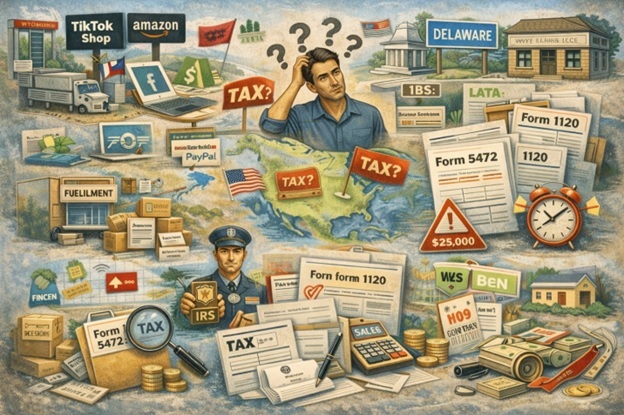
For Non-U.S. founders selling online (TikTok Shop, Amazon, Shopify), earning commissions, or providing services from abroad
Educational only — not individualized tax/legal advice. Cross-border tax depends heavily on facts (where work happens, where inventory sits, who fulfills orders, who “owns” the merchant account, etc.).
1) If I’m not living in the U.S., do I pay U.S. Social Security/Medicare (self-employment tax)?
Usually no. In most common “foreign owner + work performed entirely outside the U.S.” setups, U.S. self-employment tax is not the issue.
- Where this can change: if you actually perform services in the U.S., or you later become a U.S. tax resident, or you structure the business in a way that makes the income effectively connected with a U.S. trade or business.
2) Will a foreign owner of a U.S. LLC automatically owe U.S. federal income tax?
No, not automatically. The U.S. doesn’t tax you just because you formed a Wyoming LLC, opened a U.S. bank account, used Stripe/PayPal, or have U.S. customers.
- What drives U.S. federal income tax exposure for most foreign owners is whether the owner is considered engaged in a U.S. trade or business (USTB) and has effectively connected income (ECI).
- Common “higher risk” USTB/ECI flags (not exhaustive): U.S. employees, U.S. office, or U.S. dependent agent with meaningful authority, You personally spend significant time in the U.S. running operations, Fulfillment/inventory arrangements that create more than “mere storage/fulfillment” facts (this is highly fact-specific for ecommerce).
- Common “lower risk” facts (again, fact-specific): You perform all work abroad (marketing, strategy, customer service, management), No U.S. employees, no U.S. office, You use independent third-party logistics/marketplaces and you do not control a U.S. workforce.
3) If my foreign-owned single-member LLC is “disregarded,” why would I file anything?
Because the IRS still requires information reporting for many foreign-owned U.S. disregarded entities.
- The big one: Form 5472 + pro-forma Form 1120.
- For many foreign-owned single-member U.S. LLCs treated as disregarded entities, the LLC must file Form 5472 with a pro-forma Form 1120 attached to report “reportable transactions” between the LLC and its foreign owner (and other related parties).
- Failure to file a required Form 5472 can trigger a $25,000 penalty (and additional penalties may apply if the failure continues after IRS notice).
4) “No activity” year — do I still need Form 5472 / pro-forma 1120?
Often yes, because “no sales” is not the same as “no reportable transactions.”
- Examples of reportable transactions that commonly exist even in a “no activity” year:
- Paying formation costs (registered agent, filing fees) from personal funds.
- Capital contributions (money you put in).
- Distributions (money you take out).
- Reimbursements between you and the LLC.
- Paying a foreign contractor who is a related party (or a related foreign company).
- Bottom line: if the LLC exists, it rarely “came from thin air,” and there is often something reportable in year 1.
5) If I file late, should I still file—or just ignore it and hope for the best?
From a risk-management standpoint: file and clean it up.
- If the IRS ever raises the issue, being able to say “we discovered it, we corrected it, here’s our explanation” is generally a stronger posture than “we did nothing.”
- If no return is filed, the IRS’s assessment window generally does not start running the way it does when a return is properly filed.
6) If I get taxed in the worst case, is it on revenue or profit?
In a normal income-tax world, it’s profit (revenue minus deductible expenses).
- But there’s a critical practical point: when the IRS believes income is taxable and the taxpayer didn’t file correctly, disputes can arise over whether deductions are allowed and whether documentation is sufficient. That’s why recordkeeping + filing posture matters.
7) What is a “protective return,” and why do foreign founders use it?
A protective return is a way of saying to the IRS:
- “Here’s what I’m doing; I believe it is not taxable in the U.S.; but if you later assert it is taxable, I’m preserving my right to claim deductions and report correctly.”
- This is commonly used when the business model is cross-border and the owner wants to reduce “future surprise” risk, and/or the owner receives U.S. information forms (1099/1099-K) and wants to proactively control the narrative.
8) I received a 1099 (or 1099-K). Does that mean I owe U.S. tax?
No. A 1099 is an information form. It can increase the chance of an automated IRS question if nothing is filed, but it doesn’t by itself determine taxability.
- Key idea: facts determine tax — where the work is performed, what you’re actually doing, whether you have a USTB/ECI, and how the payment is characterized.
9) Platforms ask for W-8BEN / W-8BEN-E. Should I provide it?
Usually yes:
- W-8BEN is typically for foreign individuals.
- W-8BEN-E is typically for foreign entities.
- These forms help platforms document that you’re foreign and may affect withholding and reporting behavior. Even if a platform still issues a 1099 form, the underlying tax analysis doesn’t change automatically.
10) TikTok Shop requires an SSN—can I use someone else’s SSN “just to open it”?
This is where people get into administrative tax headaches fast.
- If a platform reports sales under someone else’s SSN, that person may receive tax forms (often 1099-K) and may need nominee/agency-style reporting to show the income is not theirs. This can be solvable, but it’s not something to “wing.”
- If your model requires a U.S. person’s SSN to act as the account holder, build a clean structure early (contracts, accounting flow, reporting plan) so the 1099 trail doesn’t blow up later.
11) If I sell products into U.S. states, do I have state tax exposure even if I’m not in the U.S.?
Yes—state tax is a separate universe from federal tax.
Sales tax (economic nexus after Wayfair)
After South Dakota v. Wayfair, states widely enforce economic nexus for sales tax. Many states use thresholds similar to $100,000 in sales (some used to include 200 transactions; many have moved away from transaction counts). A state-by-state tracker (TaxJar/Avalara) is commonly used in practice.
Practical approach:
- Track sales by state
- Register/collect once you cross the relevant threshold (or earlier if you want to be conservative)
- Use automation for filings (sales tax compliance is high-frequency and operationally heavy).
California example (illustrative):
- CA imposes an $800 minimum annual tax on LLCs “doing business” in CA, plus an additional LLC fee based on total income levels.
- CA’s “doing business” thresholds are inflation-adjusted; for 2025, the sales threshold is listed at $757,070 (check the current year when you’re planning).
And yes: you can be a nonresident and still owe state tax on state-sourced income if you meet that state’s rules.
12) If my LLC pays foreign contractors (Europe/Morocco/etc.), do I need to issue U.S. 1099s?
Often no for foreign contractors (many are documented with W-8 forms), but facts matter—especially if you start using U.S. contractors or develop a U.S. trade/business footprint.
Treat this as a compliance design issue: identify who you pay, where they are, what forms you collected, and how the business is classified.
13) Can I transfer money from my U.S. LLC to my personal account abroad?
Generally yes (wire/ACH/PayPal/etc.). The transfer method usually isn’t the tax issue—the characterization is:
- Owner contribution (money in).
- Owner distribution (money out).
- Business expense (legitimate cost of operating).
Document it in your books.
14) Do I need bookkeeping if I’m “small” or “just starting”?
You’re not legally required to use a specific software, but you do need records that can support:
- income by source.
- cost of goods sold (for ecommerce).
- platform fees, ads, shipping/returns.
- owner contributions/distributions.
- contractor payments.
- state-by-state tracking (if scaling).
You can start with spreadsheets, but ecommerce scales into “messy” quickly.
15) If I dissolve the LLC, can the IRS still come back later?
Dissolving a company does not erase potential past compliance issues. The IRS can still raise questions about prior years—especially if filings weren’t made. Also: dissolving a state entity doesn’t automatically “close” federal reporting history.
16) Do I need FBAR/foreign bank account reporting for my U.S. LLC?
If your LLC only has U.S. accounts, then FBAR typically isn’t triggered by “foreign accounts.” But if the LLC (or you, as the signatory) has non-U.S. financial accounts, foreign account reporting may apply depending on ownership/signature authority and thresholds. (This is a separate analysis.)
17) Corporate Transparency Act (BOI report): do I need to file it?
This area changed dramatically in 2025.
FinCEN issued an interim final rule stating that entities created in the United States (“domestic reporting companies”) and their beneficial owners are exempt from BOI reporting, and only certain foreign entities registered to do business in the U.S. remain in scope.
FinCEN also published updated deadlines for the remaining in-scope foreign reporting companies.
Want help setting this up correctly (and keeping it clean as you scale)?
Book a paid consult here: https://oandgaccounting.com/appointment-booking-form/