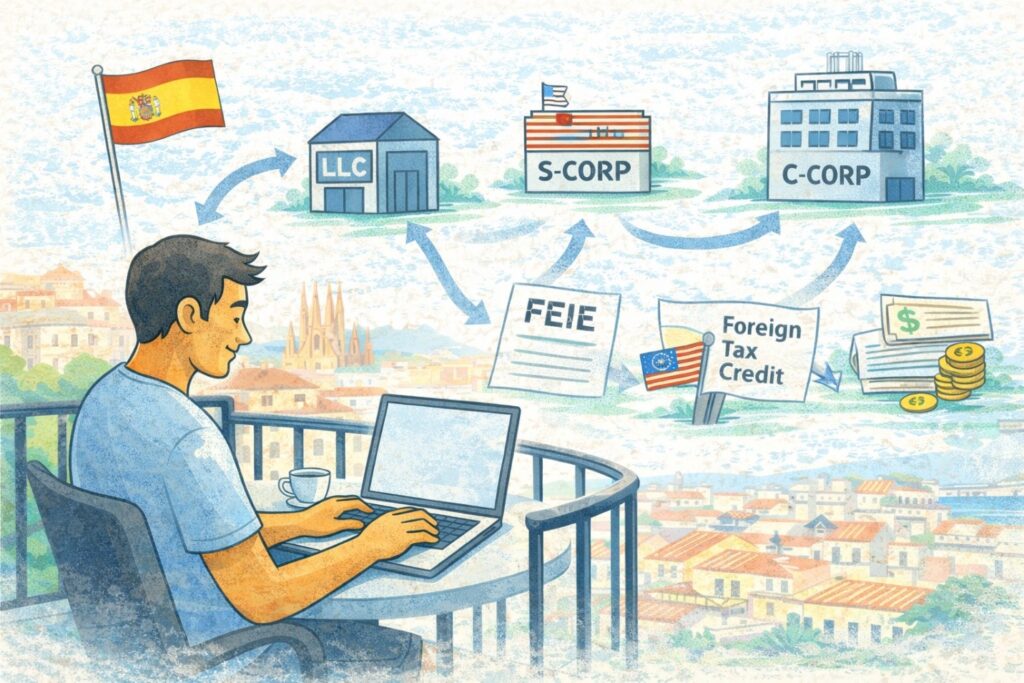
U.S. Citizen Living Abroad (Spain “Beckham Law”) Running a Remote Business: LLC vs S-Corp vs C-Corp, FEIE, Foreign Tax Credit, Payroll vs Dividends (FAQ)
If you’re a U.S. citizen (or green card holder) living abroad—especially in Spain under the “special expatriate regime” often called Beckham Law—it’s normal to hit the same questions:
- “Do I still file U.S. taxes if I live in Spain?”
- “Will Spain treat my U.S. LLC as pass-through income?”
- “Do I need a C-corp to look like a real employee for Spanish tax purposes?”
- “Can I pay myself dividends instead of salary?”
- “Can I keep profits inside the company?”
- “What about self-employment tax and Social Security coverage?”
Educational content only. Cross-border facts (residency, treaty positions, entity classification, payroll, and local law) can change outcomes.
1) I’m a U.S. citizen living in Spain. Do I still file U.S. tax returns?
Yes. U.S. citizens are generally taxed on worldwide income, even when living abroad. The main relief tools are typically:
- Foreign Earned Income Exclusion (FEIE) (Form 2555), which excludes qualifying earned income up to an annual cap (inflation-adjusted). For 2026, the cap is $132,900 (and $130,000 for 2025).
- Foreign Tax Credit (FTC) (Form 1116), which can offset U.S. tax on income also taxed abroad.
Important coordination rule: you generally can’t claim a foreign tax credit for foreign taxes paid on income you excluded using FEIE.
2) What is Spain’s “Beckham Law,” and why does it matter for U.S. entity planning?
Spain’s special regime (Article 93) can tax eligible individuals more like nonresidents, and the Spanish Tax Agency explains key mechanics, including 24% withholding on employment income and a higher rate on amounts above €600,000.
Why it matters: Spain (and many countries) often does not “see” U.S. entities the same way the U.S. does. A U.S. LLC that’s a pass-through for U.S. purposes may be treated differently abroad—sometimes unfavorably—depending on local rules. That’s why some U.S. expats consider a C-corporation structure to create a more “traditional” employer/employee arrangement.
3) LLC, S-Corp, or C-Corp: which is usually the cleanest for a U.S. citizen living abroad?
There’s no one-size-fits-all answer, but here’s the practical framing:
U.S. LLC (default pass-through)
- U.S. view: income flows to you personally.
- Foreign country view: may treat the LLC as opaque or transparent depending on local law (this is where surprises happen).
- Often fine for many expats, but can become messy if the foreign country expects wage employment to qualify for a local regime.
S-Corporation
- Only available to eligible shareholders (generally U.S. persons, not foreign individuals/entities).
- Still pass-through income to you.
- Can be great domestically, but the “pass-through” concept can collide with how your host country classifies income.
C-Corporation
- U.S. view: the corporation pays tax on its own income; you are taxed when you receive wages/dividends.
- Can be useful when you want a clear employer/employee narrative in the host country.
- Corporate tax is generally 21% at the federal level.
Big picture: If your host country’s compliance (or special regime eligibility) depends on you being an employee, a C-corp with payroll is often the cleanest “story”—but it introduces corporate compliance and potential double taxation.
4) Can I form a C-corp now and “push” last year’s income into it?
Be careful.
A common mistake is trying to “relabel” income earned personally (or under your own name) as corporate income after the fact. The conservative approach is:
- The contract should be in the corporation’s name (or properly assigned).
- The invoice should be issued by the corporation.
- The corporation should be the party that earns the income, not just the party that receives it.
Otherwise, you can run into classic U.S. doctrine problems (assignment-of-income concepts). In plain English: the IRS usually taxes income to the person/entity that actually earned it.
5) Salary vs dividends: what can FEIE exclude?
FEIE generally applies to “earned income” (wages/compensation for services), not to passive distributions like dividends.
So if your plan is:
- Pay yourself a W-2 salary from your U.S. corporation → this is the category that typically lines up with FEIE (if you meet FEIE requirements).
- Pay yourself dividends → dividends are not “earned income,” and FEIE generally won’t exclude them.
Also, dividends can be ordinary or qualified. Qualified dividends may be taxed at the long-term capital gains rates (often 0% / 15% / 20%, depending on your bracket), but only if requirements are met—especially the holding-period rule.
6) What makes a dividend “qualified”?
A common rule (with exceptions): you must hold the stock more than 60 days during the 121-day period that begins 60 days before the ex-dividend date.
If the dividend is not qualified, it’s typically taxed at ordinary income rates.
7) Can I leave profits inside the C-corp instead of paying dividends?
Yes—this is called retained earnings. Many owners retain earnings for working capital, expansion, hiring, product development, and similar business needs.
But there’s a compliance risk if a C-corp piles up earnings primarily to avoid shareholder-level tax: the Accumulated Earnings Tax regime. A commonly cited benchmark is that corporations can generally accumulate up to $250,000 without special concern (and $150,000 for certain service corporations), with facts-and-circumstances analysis beyond that.
Practical takeaway: retaining earnings is normal—just document legitimate business reasons (growth plans, reserves, future hires, major expenses, etc.).
8) If I’m abroad, do I still owe U.S. Social Security / self-employment tax?
Often, yes—especially if you’re treated as self-employed for U.S. purposes. Self-employment tax is a major surprise for many expats.
However, the U.S. has Totalization Agreements with certain countries (including Spain) to reduce double Social Security taxation. The Social Security Administration explains that certificates of coverage can establish exemption from one system when you’re covered by the other.
Practical takeaway: If you’re self-employed abroad, it’s worth checking whether you can obtain the right certificate so you’re not paying into two systems.
9) Can my corporation reimburse business travel and expenses?
Yes—if you do it correctly.
A common best practice is an accountable plan approach, where reimbursements are properly substantiated and treated as business reimbursements rather than extra taxable compensation. The IRS has guidance explaining accountable plan treatment and substantiation principles.
Practical takeaway: Use a dedicated business card/account, keep invoices/receipts, and reimburse only what is properly documented and business-related.
10) Can I pay my non-U.S. spouse as a contractor?
Sometimes yes, but cross-border payments can trigger documentation and withholding questions.
At a minimum, you typically want:
- Proper contractor agreement
- Proper invoicing
- Correct tax forms/documentation for foreign payees (often starting with a W-8 series form)
Whether withholding applies depends heavily on where services are performed and the source of the income under U.S. rules (this is a frequent “don’t guess” area).
11) I want a simple playbook. What’s the usual “clean” setup sequence?
For a U.S. person abroad aiming for clean compliance and a defensible structure, a common sequence looks like this:
- Decide entity type (often C-corp if you need an employer/employee narrative in the host country).
- Form entity + get EIN.
- Update contracts so the entity is the contracting party (or properly assign the agreement).
- Invoice through the entity and receive payment into the entity account.
- Set payroll strategy (salary level, timing, and documentation).
- Decide dividends vs retention (with an eye on qualified dividend rules and retained earnings documentation).
- Coordinate FEIE vs FTC for the individual return (don’t “double dip” by claiming FTC on excluded income).
- Confirm Social Security position (Totalization Agreement / certificate of coverage if applicable).
- Set reimbursement policy (accountable plan style).
12) What’s the single biggest mistake people make in this situation?
Trying to “paper over” timing and substance:
- A personal contract, personal invoices, personal receipt of income… and then trying to treat the income as corporate later.
- Or running reimbursements/distributions without documentation.
Cross-border planning works best when the paperwork and the money flow match the story.
If you want a clear, step-by-step plan (entity setup + contract/invoicing cleanup + payroll/dividend approach + FEIE/FTC coordination + compliance checklist), book a paid appointment here: https://oandgaccounting.com/appointment-booking-form/