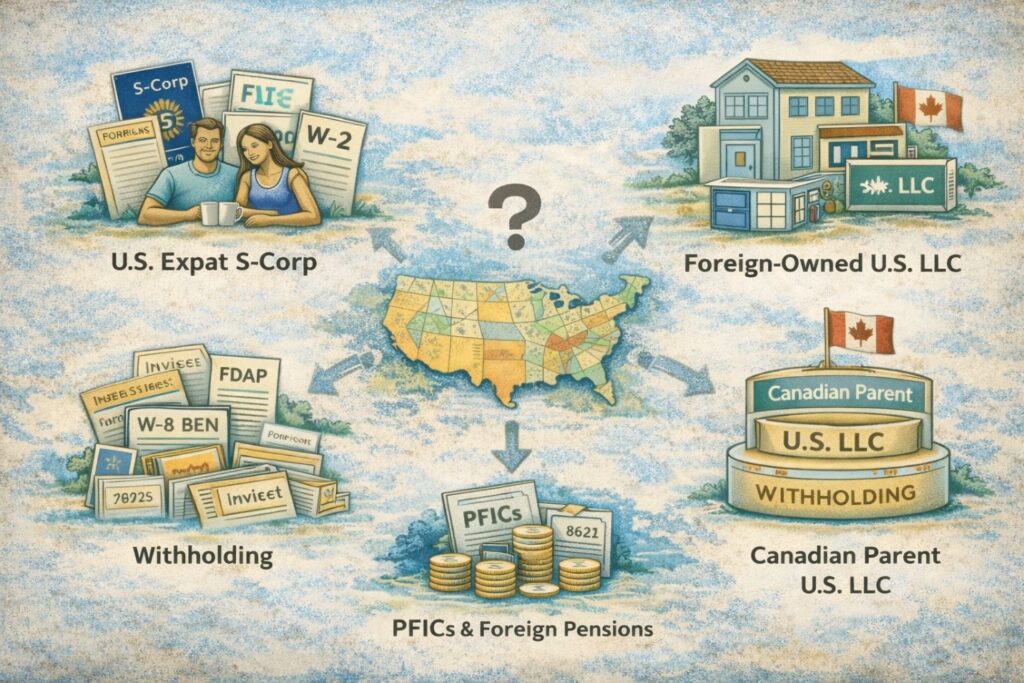
Practical guidance on S-corps abroad, Form 2555 (FEIE), foreign contractors, partnership withholding, Form 5472, PFICs, foreign pensions, and Canadian-parent U.S. LLC structures.
Important: This is general education (not legal or tax advice). Cross-border facts change the answer fast—especially where treaties, “totalization” agreements, and entity classification are involved.
1) I’m a U.S. citizen living abroad. Can I use an S-Corp to reduce U.S. taxes?
Yes—but only if it’s run correctly.
An S-corp splits what you receive into two broad buckets:
- W-2 wages (salary) paid to you as an employee.
- Pass-through business profit reported on your personal return (even if you don’t distribute cash).
For expats, the core planning issue is that Form 2555’s Foreign Earned Income Exclusion (FEIE) generally applies to earned income (like wages), but does not exclude S-corp pass-through profit (because pass-through profit is not “earned income” in the FEIE sense).
2) FEIE 2025: what’s the exclusion amount—and why does it matter for S-corp salary?
For the 2025 tax year, the maximum FEIE is $130,000.
This matters because only the wage portion (if it qualifies) can potentially be excluded under FEIE—not the S-corp’s pass-through profit.
Common misconception
“I’ll pay myself exactly the FEIE limit as salary, exclude it all, and take the rest as pass-through profit.”
It can create reasonable compensation risk (see next FAQ). FEIE planning does not override the requirement to pay reasonable wages for the work performed.
3) Is there a “best ratio” of salary vs. distributions at $120K or $200K?
There is no safe universal ratio. The “right” salary is the salary that is reasonable for the services you actually perform, considering:
- your role, skills, and hours,
- industry pay data,
- business profitability,
- what you would pay someone else to do your job.
Practical planning lens (how pros usually think about it)
- Too low salary → higher IRS risk (reclassification of distributions to wages + payroll tax, penalties, interest).
- Too high salary → you may overpay payroll taxes or reduce flexibility.
Key point: FEIE is helpful, but you do not set salary because of FEIE; you set salary based on reasonable comp, then plan around it.
4) If I work abroad, do I still owe U.S. Social Security/Medicare (FICA) on S-corp wages?
Often, yes—but this is where expat rules get tricky.
Two critical rules
- FEIE does not reduce Social Security/Medicare taxes (or self-employment tax).
- A totalization agreement (U.S. + certain countries) may shift social security coverage to one country and exempt the other—usually by getting a Certificate of Coverage.
Wage base reality check
Social Security tax applies only up to the annual wage base (changes each year).
- 2025 wage base: $176,100
- 2026 wage base: $184,500
Bottom line: Don’t assume “no FICA because I’m abroad.” Instead, analyze (a) whether FICA would apply under U.S. rules and (b) whether a totalization agreement changes the answer.
5) If I’m half W-2 (for someone else) and half self-employed abroad, how do I handle foreign housing on Form 2555?
Foreign housing benefits come in two flavors:
- Housing exclusion (generally for employees)
- Housing deduction (generally for self-employed)
If you have a mix of wages and self-employment income, you typically compute housing amounts under the Form 2555 framework and apply the correct treatment based on the income type. The form mechanics are not always intuitive, but the key is: the housing benefit is tied to foreign earned income and qualifying housing expenses, and then applied as exclusion vs. deduction depending on your status.
6) Can an expat take the QBI deduction (Section 199A) if the work is performed outside the U.S.?
Usually not—if the income is not connected to a U.S. trade or business.
The QBI rules generally hinge on whether the income is effectively connected with a U.S. trade or business (this “ECI” concept shows up explicitly in the IRS instructions).
Practical takeaway: If your consulting/marketing work is performed entirely abroad and you have no U.S. trade or business, QBI is often off the table.
7) If FEIE wipes out my income tax, do I still need quarterly estimated payments?
It depends on what taxes remain.
- If you’re self-employed (Schedule C or partnership income), self-employment tax can still apply, and FEIE doesn’t eliminate it.
- If you’re an S-corp employee, payroll taxes are generally handled through withholding and employer deposits, not quarterly estimates.
Also consider totalization agreements, which can eliminate U.S. social security taxes in some cases.
8) I pay foreign contractors from my U.S. S-Corp. Where do I deduct it, and do I need 1099s?
Where to deduct
Most businesses report this as:
- Contract labor / contractor expense, or
- “Other deductions” with an attached statement.
The IRS generally cares more about substantiation than whether you label it “foreign” or not.
1099 issue (common confusion)
- U.S. contractors often require Form 1099-NEC reporting.
- Non-U.S. contractors performing services outside the U.S. typically do not get a 1099-NEC—but you should document their foreign status (commonly via W-8 forms) and keep invoices/contracts.
Best practice: Separate “U.S. contractors” vs “non-U.S. contractors” in bookkeeping if it helps your compliance workflow, but it’s not mandatory for a clean return.
9) Partnership withholding mistake: we withheld (Forms 8804/8805) but later learned there was no ECI. How do we get the money back?
If withholding was paid in and credited to the foreign partners, refunds are typically claimed at the partner level via their U.S. nonresident return—because the IRS treats the withholding as a prepayment/credit tied to the partner. The partnership withholding regime is explained in the IRS instructions for Forms 8804/8805.
Forward-looking fix
If there is no effectively connected taxable income, the partnership generally shouldn’t be making 1446 withholding payments going forward. (Expect the IRS to sometimes issue automated letters when foreign partners exist—those often require a response explaining why withholding does not apply.)
10) Royalties to nonresident owners: can a U.S. C-Corp “management fee” structure reduce 30% withholding?
Sometimes, but it can also create new problems:
- U.S. corporate income tax exposure,
- personal holding company considerations (in narrow cases),
- transfer pricing support (arm’s-length fees),
- whether the royalty is still U.S.-source FDAP and still subject to withholding.
This is an area where “simple” restructures can backfire. Treat it as a memo-first planning project, not a quick fix.
11) Canadian corporation owns 100% of a U.S. single-member LLC. Do we have branch profits tax exposure?
Branch profits tax is a concern only if the foreign corporation is engaged in a U.S. trade or business and has effectively connected income (ECI). The IRS describes the branch profits tax regime in the Form 1120-F instructions (IRC §884).
If there’s no U.S. trade or business / no ECI, branch profits tax generally doesn’t apply.
12) Does using a U.S. payment processor or a U.S. 3PL automatically create U.S. trade or business?
Not automatically. The tax analysis is usually about substance:
- Do you have a U.S. office?
- Do you have employees or dependent agents in the U.S. with authority to bind you?
- Is the warehousing/logistics provider truly an independent service provider serving many clients?
State tax is a separate topic: inventory stored in a state can create sales tax / income tax nexus even where federal income tax ECI is not triggered.
13) If FDA paperwork lists a U.S. LLC as “importer,” does that alone create U.S. ECI?
Usually, a label on a compliance document doesn’t control the income tax outcome by itself. It can raise questions, but the tax answer typically depends on what actually happens in practice (people, offices, contracting authority, where services are performed, etc.). Document the facts and the reason the address/entity is used.
14) Foreign-owned U.S. single-member LLC with no ECI: what’s the recurring IRS filing?
Commonly:
- Form 5472 + pro-forma Form 1120 (information reporting for foreign-owned disregarded entities)
Penalty warning: The IRS instructions emphasize that Form 5472 penalties can be $25,000 (and can increase with continued failure).
Also, remember: “reportable transactions” can include owner contributions, distributions, loans, intercompany payments, etc.—so bookkeeping isn’t optional if you want to stay compliant.
15) Do the U.S. LLC and foreign parent need the same fiscal year?
It’s cleaner when they align, but the practical answer depends on:
- whether the U.S. entity is taxable in the U.S.,
- what the information reporting period is,
- and how your books are maintained.
If the U.S. LLC is only filing Form 5472 / pro-forma 1120 (and there’s no taxable ECI), the key is consistency and accurate reporting.
16) PFICs: should immigrants sell foreign mutual funds before becoming U.S. tax residents?
PFICs are one of the most punitive parts of the U.S. international tax system. In many cases, yes, people consider cleaning up PFIC exposure before U.S. residency—because post-residency reporting and potential tax/interest-charge mechanics can be painful.
If they’ve already become U.S. persons, the focus shifts to:
- identifying PFICs,
- choosing a defensible reporting strategy (often involving elections where possible),
- and correcting past filings if needed.
17) Foreign pensions/retirement funds: if I don’t take distributions after I move to the U.S., am I taxed anyway?
Often, U.S. tax triggers on foreign retirement plans depend on:
- whether the plan is treated as a pension vs. trust,
- whether contributions were deductible or taxable,
- whether income is accumulating in a way the U.S. taxes currently,
- and whether a treaty applies.
A common baseline principle: distributions are taxable when received, but plan classification can create additional reporting or current-tax rules. This is very country-specific—treat it as a “facts + documents” analysis, not a one-size answer.
18) Foreigners investing in U.S. real estate: what’s the most common structure?
There isn’t one universal “best,” but the most common structures are:
- Direct ownership (sometimes for simplicity),
- U.S. LLC (liability containment; often disregarded or partnership),
- U.S. corporation “blocker” (sometimes used for estate tax/privacy/structuring reasons).
The “best” structure depends heavily on:
- estate tax exposure,
- liability concerns,
- financing,
- exit strategy,
- FIRPTA/withholding considerations,
- and whether the investor will have U.S. trade or business activity.
20) First year S-Corp: I took draws earlier. Can I reclassify them as wages and “true-up” payroll at year-end?
Often, yes—if handled correctly.
A common approach is to treat earlier draws as an employee advance and then run a year-end payroll that:
- reports the wages correctly,
- deposits the payroll taxes,
- and produces accurate quarterly/year-end payroll filings.
For most taxpayers, using a payroll system/provider is the safest route because payroll compliance is about forms + deposit timing, not just the W-2.
21) Expat health insurance premiums: can I deduct foreign health insurance?
Often yes, but the mechanism depends on the structure:
- Schedule C (LLC taxed as sole prop): may qualify for the self-employed health insurance deduction (with limitations).
- S-Corp (2% shareholder): commonly handled via a reimbursement/plan approach, with the premium included in income appropriately and then deducted on the shareholder’s return as an above the line deduction, to then extent of the S corp net income.
Keep:
- policy documents,
- proof of payment,
- and an internal reimbursement record if the company pays/reimburses.
Quick “Do/Don’t” Checklist (High-Impact)
Do
- Keep clean books (especially for Form 5472 reportable transactions).
- Separate wages vs. distributions in an S-corp.
- Treat payroll taxes and totalization as a separate analysis from FEIE.
- Document foreign contractor status (W-8 + invoices/contracts).
- Expect IRS letters when foreign partners/owners appear—respond with facts.
Don’t
- Set S-corp salary purely based on the FEIE maximum.
- Assume “working abroad = no payroll tax.”
- Treat PFICs casually after U.S. residency begins.
Ready for a Professional Review of Your Cross-Border Tax Setup?
If you’re a U.S. expat, a nonresident with a U.S. LLC, or a foreign-owned structure dealing with Form 5472, S-corp salary vs. distributions, Form 2555 (FEIE), foreign contractors, PFICs, foreign pensions, or Canadian-parent U.S. LLC planning, the smartest next step is a short, structured consult to confirm the facts and lock in a defensible filing position. Book a paid appointment with O & G Tax and Accounting Services here: https://oandgaccounting.com/appointment-booking-form/